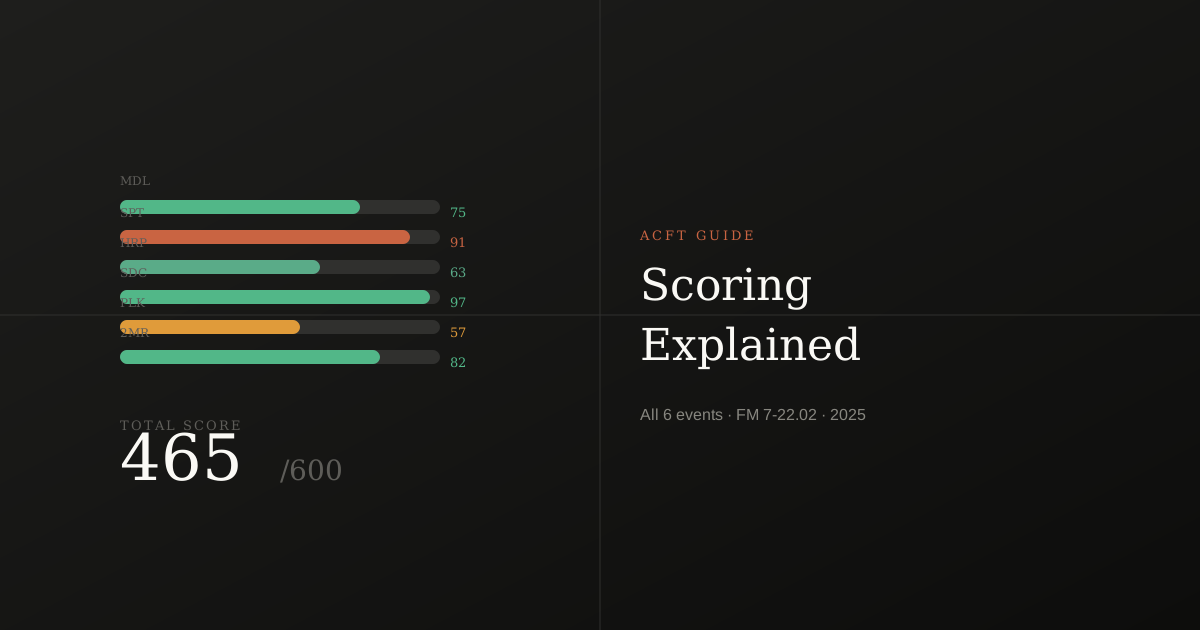
Complete breakdown of all 6 ACFT events: scoring tables, pass/fail criteria, linear interpolation, and what changed from the APFT.
The Army Combat Fitness Test replaced the Army Physical Fitness Test in April 2022, and with that change came a completely new scoring system. If you've been in the Army for a while, the ACFT scoring method probably feels different. And it is. This guide walks through exactly how every event is scored, what the numbers mean, how points are calculated between table values, and how to interpret your results in a competitive context.
Use the ACFT calculator at any point to check your scores as you read through the tables.
The Core Scoring Principle
Every ACFT event is scored on a 0 to 100 point scale. Your total score is the sum of all six events, giving a maximum possible score of 600 points.
The minimum passing score is 60 points per event. You must pass every individual event. There's no "average" passing mechanism, no ability to bank strong performance in one event against a weak event in another. If you score 100 on five events and 59 on one, you fail the entire test.
This is fundamentally different from the APFT, where a single combined total determined pass/fail. The ACFT demands minimum competency across every fitness domain it tests, which directly reflects the Army's argument that combat tasks don't become easier because a soldier is excellent in a different physical category.
The six events are administered in a fixed order: MDL, SPT, HRP, SDC, PLK, 2MR. This order is intentional. Strength events come first when you're fresh, and aerobic endurance comes last. Rest periods between events vary by command policy but typically range from 10 to 20 minutes.
Complete Event-by-Event Scoring Tables
1. 3 Repetition Maximum Deadlift (MDL)
The deadlift measures lower-body and grip strength. You perform three consecutive repetitions with a hex (trap) bar. You may attempt the same or increasing weight for up to three total attempts. Your highest successful 3-rep weight determines your score.
Input: Weight in pounds | Direction: Higher is better | Minimum pass: 205 lbs = 60 points
| Weight (lbs) | Points | Weight (lbs) | Points |
|---|---|---|---|
| 140 | 0 | 250 | 76 |
| 155 | 18 | 265 | 79 |
| 170 | 34 | 280 | 82 |
| 185 | 46 | 295 | 85 |
| 205 | 60 ✓ | 310 | 88 |
| 215 | 64 | 320 | 90 |
| 230 | 70 | 330 | 95 |
| 240 | 74 | 340 | 100 |
The MDL scoring curve is front-loaded. Significant point gains occur between 140 and 250 lbs, with diminishing returns above 280 lbs. Going from 200 to 220 lbs gains 8 points. Going from 300 to 320 lbs gains only 4 points.
Use the deadlift calculator to find the exact score for any weight, including interpolated values between table entries.
2. Standing Power Throw (SPT)
The SPT measures explosive full-body power. You throw a 10-pound medicine ball overhead and backward for maximum distance. The longer of two attempts counts. You cannot step outside the designated throwing zone.
Input: Distance in meters | Direction: Higher is better | Minimum pass: 7.3 m = 60 points
| Distance (m) | Points | Distance (m) | Points |
|---|---|---|---|
| 3.3 | 0 | 7.3 | 60 ✓ |
| 4.5 | 30 | 8.5 | 72 |
| 5.5 | 45 | 9.5 | 82 |
| 6.5 | 56 | 10.5 | 92 |
| 6.9 | 58 | 11.0 | 96 |
| 7.1 | 59 | 12.5 | 100 |
The scoring curve in the middle range (7 to 10 meters) is particularly efficient for training investments. Each additional half-meter in this zone adds 4 to 6 points.
Use the power throw calculator for exact distance-to-score conversions.
3. Hand-Release Push-Ups (HRP)
The HRP tests upper-body muscular endurance. In two minutes, complete as many hand-release push-ups as possible. At the bottom of each rep, both hands must fully leave the ground before pressing back up.
Input: Repetitions | Direction: Higher is better | Minimum pass: 20 reps = 60 points
| Reps | Points | Reps | Points |
|---|---|---|---|
| 10 | 0 | 20 | 60 ✓ |
| 13 | 24 | 25 | 70 |
| 15 | 40 | 30 | 76 |
| 17 | 48 | 40 | 86 |
| 18 | 52 | 50 | 95 |
| 19 | 56 | 60 | 100 |
The scoring steps quickly in the early range: each rep from 10 to 20 is worth roughly 6 to 8 points. Above 20, each additional rep is worth 1 to 2 points. That means the difference between failing and passing is just a few well-trained reps.
Use the push-ups calculator for exact rep-to-score conversions.
4. Sprint-Drag-Carry (SDC)
The SDC is a five-phase shuttle run: sprint 25m, drag a sled backward 25m, lateral shuffle left and right 25m each, carry two 40-lb kettlebells 25m, sprint 25m. Total distance is 50 meters of linear distance across five phases.
Input: Time in MM:SS | Direction: Lower is better | Minimum pass: 2:12 = 60 points
| Time | Points | Time | Points |
|---|---|---|---|
| 1:33 | 100 | 2:12 | 60 ✓ |
| 1:36 | 95 | 2:18 | 54 |
| 1:39 | 90 | 2:30 | 38 |
| 1:48 | 84 | 2:45 | 20 |
| 2:00 | 76 | 3:00+ | 0 |
| 2:06 | 70 |
The SDC scoring table is steep. Every 6-second improvement is worth 2 to 4 points in the critical range around 2:00 to 2:30. This makes targeted SDC training one of the more efficient investments for soldiers near the passing threshold.
Use the SDC calculator to check your time.
5. Plank (PLK)
The plank measures core endurance. Hold a forearm plank position for as long as possible. Once you break position (hips sag, hips pike, knees touch, or elbows shift), the event ends immediately with no restart.
Input: Time in MM:SS | Direction: Higher is better | Minimum pass: 2:54 = 60 points
| Time | Points | Time | Points |
|---|---|---|---|
| 1:30 | 0 | 2:54 | 60 ✓ |
| 2:00 | 25 | 3:00 | 62 |
| 2:12 | 34 | 3:30 | ~76 |
| 2:30 | ~38 | 3:36 | 78 |
| 2:42 | 56 | 4:00 | 100 |
The PLK replaced both the old APFT sit-up and the original ACFT leg tuck. The scoring table advances in 6-second increments across most of the range, making every 30 seconds of improvement worth approximately 10 to 15 points in the 2:30 to 3:30 zone.
Use the plank calculator to find your current score.
6. Two-Mile Run (2MR)
The 2MR tests aerobic endurance, the same event format the Army has used for decades. Run 2 miles on a measured, flat outdoor course as fast as possible. Treadmill runs aren't authorized for official testing.
Input: Time in MM:SS | Direction: Lower is better | Minimum pass: 14:54 = 60 points
| Time | Points | Time | Points |
|---|---|---|---|
| 13:30 | 100 | 14:54 | 60 ✓ |
| 13:36 | 95 | 15:00 | 58 |
| 13:42 | 90 | 15:30 | ~48 |
| 14:00 | 84 | 16:00 | ~38 |
| 14:24 | 76 | 17:00 | ~20 |
| 14:42 | 68 | 21:00+ | 0 |
The 2MR scoring is relatively linear across the full range. Each additional minute of run time costs roughly 15 to 20 points. Use the two-mile run calculator for exact time-to-score conversions.
How Linear Interpolation Works
The Army doesn't just use the exact values in the scoring tables. It uses linear interpolation for performance values that fall between listed entries. This is how all official scoring is calculated, and it's how the ACFT calculator computes your exact score.
A Plain-Language Example
The MDL scoring table shows:
- 240 lbs = 74 points
- 245 lbs = 75 points
If you deadlift 242 lbs, your score is interpolated proportionally:
- The gap between 240 and 245 is 5 lbs
- 242 lbs is 2 lbs above the lower entry (2/5 = 40% of the way through the interval)
- Points gap is 75 − 74 = 1 point
- 40% of 1 point = 0.4 points, added to 74
- Final score: 74.4 → typically rounded to 74
This matters because it means your exact performance is always scored accurately, not just rounded down to the nearest table value. Our calculator applies this interpolation automatically for every input.
A Time-Based Example
For the 2MR, the table shows:
- 14:42 = 68 points
- 14:48 = 66 points (the table advances in 6-second increments)
If you run 14:45:
- 14:45 is 3 seconds above 14:42 (half of the 6-second interval)
- Points gap: 68 − 66 = 2 points
- 50% of 2 = 1 point subtracted from 68
- Final score: 67
Linear interpolation ensures you get credit for every second and every pound, not just the nearest rounded table entry.
What Your Total Score Means
The ACFT has no minimum total score, only per-event minimums of 60 points. But total scores carry meaning in competitive contexts, and understanding the total score range helps you set appropriate goals.
Score Range Interpretation
| Total Score | Average per Event | Level |
|---|---|---|
| 540 to 600 | 90 to 100 | Exceptional |
| 480 to 539 | 80 to 89 | Strong |
| 420 to 479 | 70 to 79 | Solid |
| 360 to 419 | 60 to 69 | Passing with minimum margin |
| Below 360 | Below 60 average | At risk of failing individual events |
Competitive Context by Career Stage
Initial entry soldiers: Scores of 360 to 420 (just passing all events) are common early in a military career, especially for soldiers without strength training backgrounds. The MDL and SDC are often the bottlenecks.
Junior enlisted (E-4/E-5): Scores of 420 to 480 represent solid performance. NCOs and leadership development programs increasingly consider ACFT scores as performance indicators.
NCO candidates: Senior NCO positions and NCOES courses at advanced levels may consider competitive ACFT scores. Scores of 480+ are generally considered strong in competitive packet evaluation.
Senior NCOs and Officers: Total scores of 500+ with no failing events are considered competitive for senior selection boards and special assignment opportunities. The 540+ range represents genuinely exceptional fitness.
Note: These are general guidelines, not published Army policy on minimum scores for specific assignments. Unit and command policies vary.
Pass/Fail Logic and Consequences
The All-Events Requirement
Every single event must independently meet the 60-point threshold. The math is unforgiving:
- Score 100 on five events + 59 on one event = FAIL
- Score 60 on all six events (total: 360) = PASS
- Score 61 on five events + 59 on one event = FAIL
The practical implication: one weak event can fail you regardless of how strong your other events are. That's why identifying and prioritizing failing or borderline events is the most important training decision a soldier can make.
Administrative Consequences of Failing
-
Administrative flag: Flags block promotions, awards, and attendance at professional development courses. A flag from a failed ACFT can affect a soldier's career timeline significantly.
-
90-day retest window: Soldiers who fail receive 90 days to retake the test. The 90-day clock typically starts from the date of the failed test.
-
Repeated failure: Soldiers who fail multiple consecutive ACFTs face increasingly serious consequences including assignment limitations and retention review.
-
Medical exceptions: Soldiers with documented medical conditions may qualify for alternative scoring, event exemptions, or delayed testing. These require medical documentation and command approval.
Diagnostic vs. Official ACFTs
Not every ACFT you take counts on your official record. Understanding the difference matters for how you approach each test.
Diagnostic ACFT: Administered by a unit or commander to assess readiness. Results aren't officially recorded and don't create a flag if failed. These are practice runs and should be used regularly throughout the year to track progress.
Record ACFT: Formally administered with a certified OIC and trained graders. Results are recorded on DA Form 705 and entered into DTMS (Digital Training Management System). This is the test that counts for promotions, assignments, and flags.
The Army requires at minimum two record ACFTs per year. Commands may conduct additional diagnostic tests at any frequency.
Grading Standards and What to Do If You Disagree
Who Grades the ACFT
The ACFT must be administered by a certified OIC (Officer in Charge) and scored by trained graders, soldiers who have completed official ACFT grader training. This standardization was a key improvement over the APFT, where grading quality varied significantly by unit.
Each event has specific grader positioning and criteria. For example, the HRP grader watches for hand contact with the ground and counts only clean reps. The MDL grader ensures 3 full reps reach lockout with no hitching.
If You Believe a Grader Made an Error
If you believe a graded repetition, form fault, or time call was incorrect:
- Immediately (politely) request clarification from the grader
- If unresolved, request a regrade from the test OIC before leaving the station
- Document any concerns in writing as soon as possible after the test
Grader errors do happen, particularly on events with subjective elements (HRP hand release, PLK hip alignment). Addressing concerns immediately, before moving to the next event, is more likely to result in resolution than raising them after the test concludes.
Score Recording and Official Documentation
Your official ACFT score is recorded on DA Form 705 (Army Physical Fitness Test Scorecard), which has been updated for ACFT format. The form captures:
- Date of test
- All six event scores
- Total score
- Pass/fail status
- Grader and OIC signatures
Scores are entered into DTMS (Digital Training Management System), which is the authoritative system of record for fitness test results in the Army. Soldiers should verify their scores appear correctly in DTMS within a few days of testing.
Keep a personal copy of your DA Form 705. It's the primary documentation of your test performance and is referenced for promotion boards, school applications, and security clearance reviews.
What Changed From the APFT
The old Army Physical Fitness Test had three events: push-ups, sit-ups, and a two-mile run. It used age- and gender-adjusted scoring tables. The ACFT changed the fundamental architecture of the test in several ways:
Events expanded from 3 to 6, adding deadlift, power throw, and sprint-drag-carry, replacing sit-ups with the plank, and modifying push-ups to require the hand release.
Universal scoring standards. All soldiers scored identically regardless of age or gender. The APFT's age/gender adjustments meant very different physical performances earned the same score for different demographic groups.
Pass/fail logic is stricter. The APFT allowed averaging across events in some configurations. The ACFT requires 60 points on every event independently.
Functional fitness focus. Each ACFT event was selected to assess physical qualities relevant to combat tasks: the deadlift simulates picking up a casualty or equipment, the power throw relates to grenade-throwing range, and the SDC simulates a casualty drag and equipment carry.
For a full historical comparison including performance impact by demographic group, see ACFT vs APFT: What Changed and Why It Matters.
Using This Calculator to Improve Your Score
The most efficient way to improve your ACFT total score is to identify your weakest events and direct training resources there. A 10-point gain on a failing event is worth more than a 10-point gain on an event already scoring 85+.
Use the full ACFT calculator to:
- Score all your current numbers in one view
- See which events are passing vs. failing
- Set target performance for each event and see the required improvement
- Track progress over weeks and months
The event-specific calculators let you explore specific targets quickly:
- Deadlift calculator
- Power throw calculator
- Push-ups calculator
- SDC calculator
- Plank calculator
- Two-mile run calculator
For training guidance to improve specific events, see the 12-Week ACFT Training Plan and the event-specific training guides. For information on our data sources and scoring methodology, see the About page.
Frequently Asked Questions
What is the minimum score to pass the ACFT? You must score at least 60 points on each of the 6 events individually. There's no minimum total score, but since you need 60 × 6 = 360 to pass all events, 360 is effectively the minimum total for a passing test. Scoring 359 total, with one event at 59, is still a failure.
Can I pass with a 59 on one event? No. A score of 59 on any single event is a failure regardless of performance on the other five events. The 60-point threshold is a hard minimum for each event independently.
Are ACFT scores the same for men and women? Yes. The ACFT uses gender-neutral scoring. All soldiers are scored against the same performance standards regardless of gender or age. This was the most significant policy change from the APFT and applies to all record tests.
How accurate is this calculator? The scores are based directly on FM 7-22.02 lookup tables with linear interpolation applied for values between table entries, exactly matching the official Army scoring methodology. For a detailed explanation of our data sources and methods, see the About page.
How does the scoring change year to year? The ACFT scoring tables are established in FM 7-22.02 and have been stable since the 2022 full rollout. Any official changes would be published in a new edition of the FM. This calculator reflects the current 2025 standards as published.
What if my test was scored without interpolation, just rounded down? Official Army scoring must use interpolation. If your graders rounded to the nearest table entry rather than interpolating, your recorded score may be slightly lower than your actual performance warranted. This is uncommon in formal testing environments but can occur in informal diagnostic tests. The scores on this calculator reflect the correct interpolated method.
Free Calculator
Ready to check your score?
Use the free ACFT calculator to instantly score all 6 events based on official FM 7-22.02 standards.
Open ACFT Calculator →Related Articles
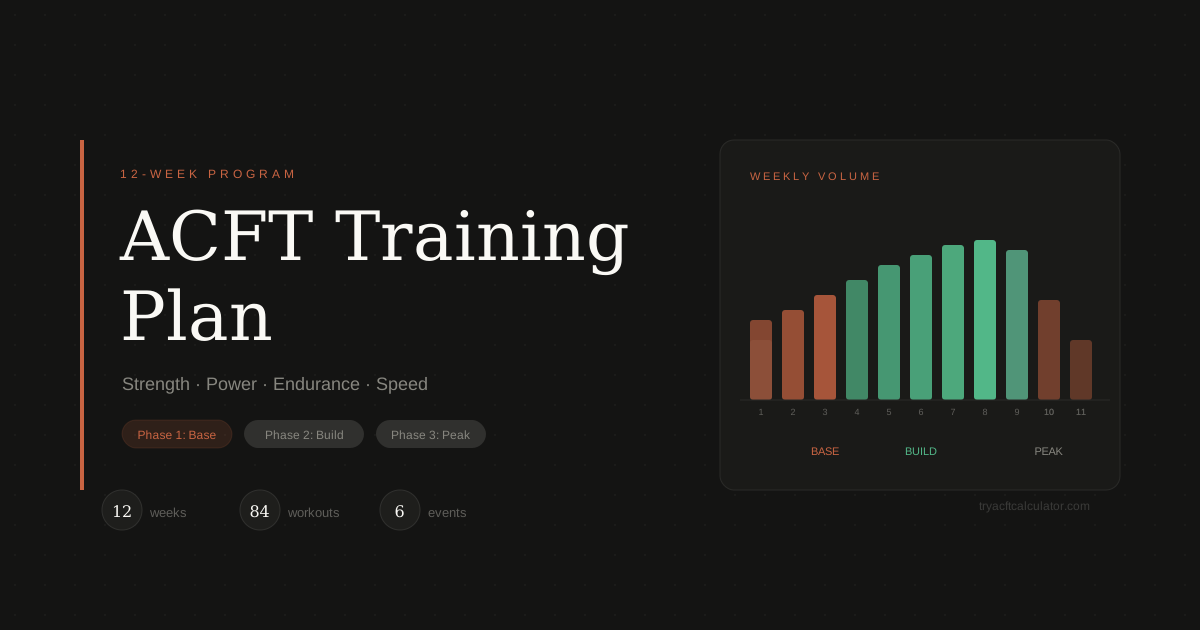
12-Week ACFT Training Plan to Max Your Score
Week-by-week ACFT training plan with periodization, event-specific programming, assessment week, nut…
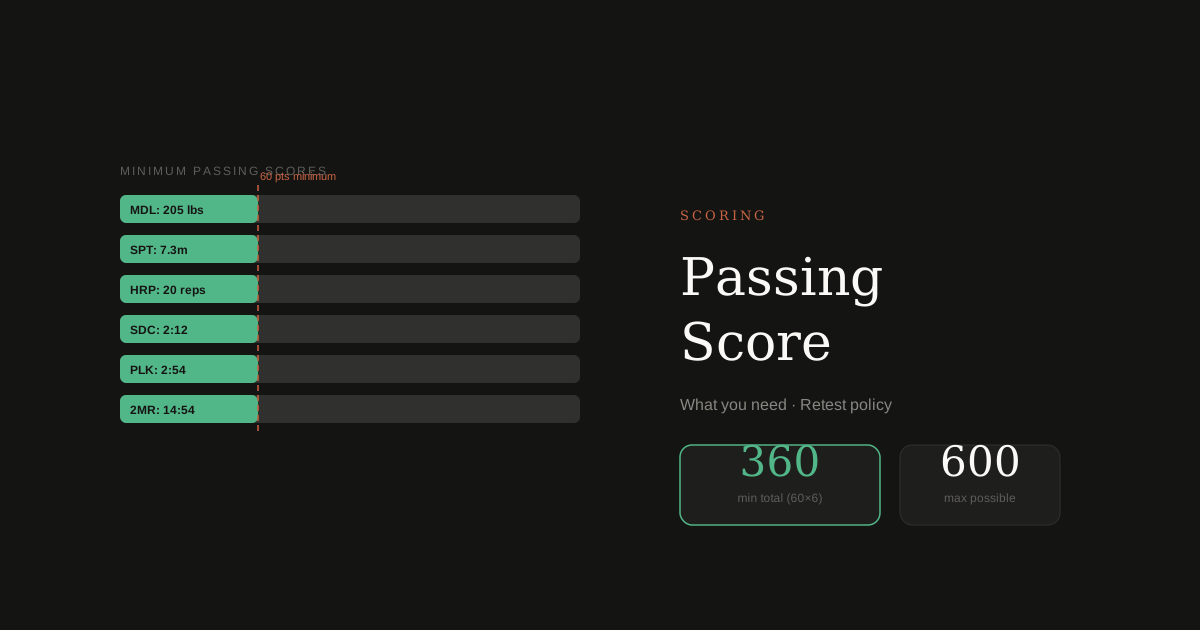
ACFT Passing Score: Minimums, Requirements & Retest Policy
Everything you need to know about ACFT minimum scores, per-event passing thresholds, what a perfect …
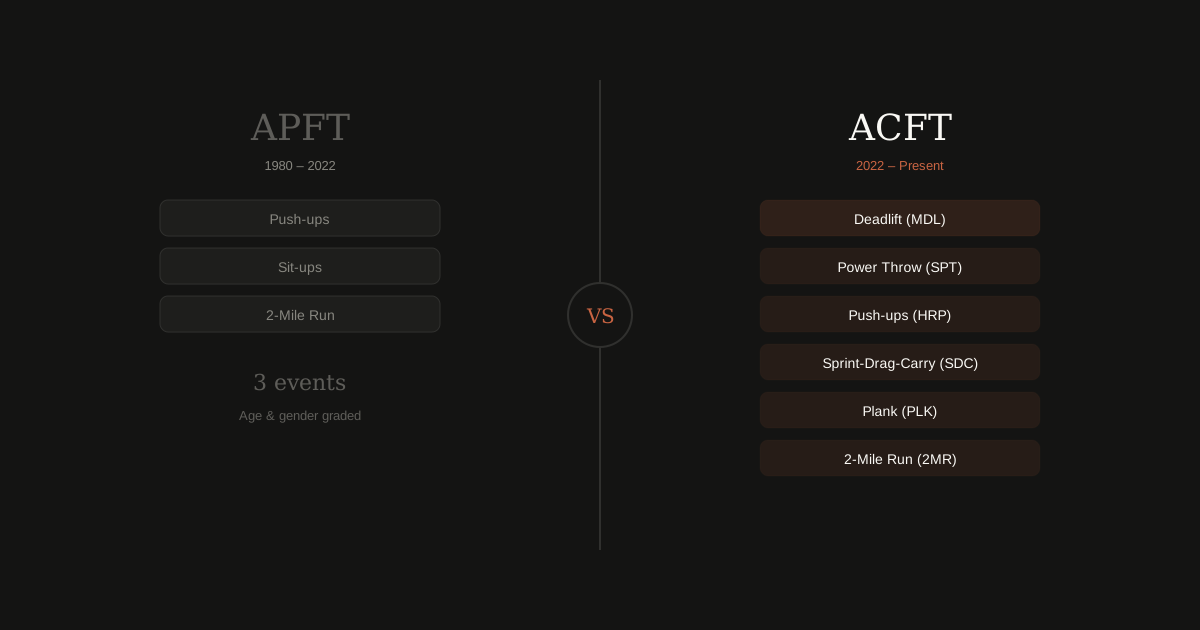
ACFT vs APFT: What Changed and Why It Matters
Side-by-side comparison of ACFT vs APFT: history, event differences, scoring philosophy, what got ha…