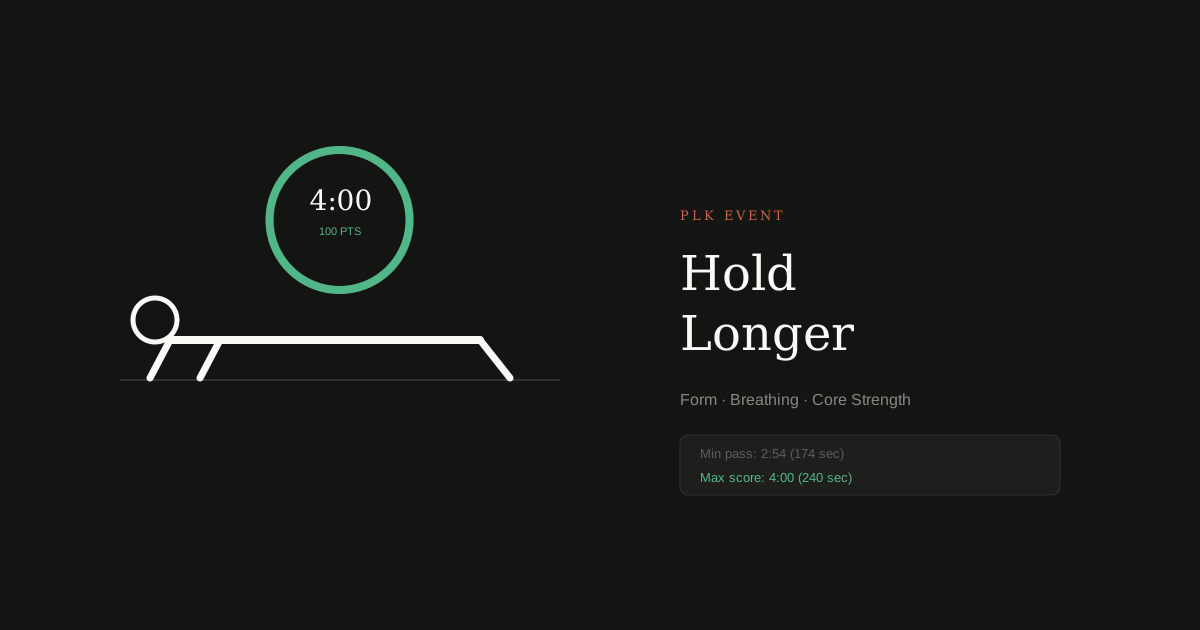
Complete guide to the ACFT plank event. Official standards, proper form, 8-week progressive training program, and mental strategies to max your PLK score.
The plank replaced the sit-up as the ACFT's core endurance event, and for soldiers who have never specifically trained isometric core holds, it can be a surprising challenge. The minimum passing time is 2:54. That's nearly three minutes in a fixed position. The 100-point standard is 4:00. This guide gives you everything you need to improve your plank score from any starting point: the official standards, the anatomy behind it, an 8-week progressive training program, supplementary exercises, and the mental strategies that separate soldiers who hold 2:30 from soldiers who hold 4:00.
Check your current score with the plank calculator, then use the full ACFT calculator to see your complete picture.
Why the Plank Replaced the Leg Tuck (and Sit-Up Before That)
To understand why the ACFT plank matters, it helps to know the event's history. The original Army Physical Fitness Test used the sit-up as its core assessment for decades. Sit-ups were replaced in the ACFT's initial 2018 rollout with the leg tuck, a hanging knee-raise from a pull-up bar. The leg tuck tested core and pulling strength at the same time, but it quickly revealed a problem. Failure rates were disproportionately high among female soldiers and soldiers with limited upper-body pulling strength, and graders had difficulty standardizing what counted as a passing repetition.
In 2022, the Army replaced the leg tuck with the plank hold. The plank offered three advantages over both prior events:
- Standardization: The pass/fail criteria for a forearm plank is clear and objective. Either your hips are level or they aren't.
- Injury profile: The plank doesn't involve repetitive spinal flexion under load, which sit-ups do at high volume. It also doesn't require the shoulder and elbow positioning that created injury risk in the leg tuck.
- Functional transfer: Isometric core stability is directly relevant to load carriage, marksmanship, and physical labor. Tasks soldiers perform regularly.
The sit-up rewarded hip flexor dominance. The plank rewards true anterior core endurance. That's a meaningful distinction for performance and injury prevention.
Official ACFT Plank Standards
The PLK is governed by FM 7-22.02. Every detail of the position matters because any form fault ends the event immediately.
Legal Position Requirements
- Support surface: Forearms flat on the ground, elbows directly beneath the shoulders
- Foot position: Feet together, or up to boot-width apart (the test OIC specifies which applies on test day, so practice both)
- Body alignment: A straight line from head to heels. No sagging, no piking
- Head position: Neutral. Not cranked up to look at the grader, not drooping toward the floor
- Hip height: Hips must stay level throughout the hold, neither elevated above the shoulder-heel line nor sagging below it
What Causes Immediate Event Termination
The grader calls time the moment any of these faults occur:
- Hip sag, the most common failure. Lower back fatigues and the pelvis drops
- Hip pike, pushing hips up to relieve core tension. Also ends the event
- Knees touching the ground, any contact between knee and floor
- Elbow movement, shifting your elbow position to adjust your angle
- Feet lifting, toes must stay in contact with the ground throughout
There is no warning and no second chance. Once the grader calls time, the event is over with whatever time you've accumulated.
Full Scoring Breakdown
The PLK scoring table rewards time held in 6-second increments across most of the range. Knowing the exact scoring curve tells you where extra training effort produces the most points.
| Time | Points | Notes |
|---|---|---|
| Under 1:30 | 0 | Below minimum table value |
| 1:30 | 0 | Table minimum |
| 2:00 | 25 | Common starting point for untrained soldiers |
| 2:30 | ~38 | Approaching pass threshold |
| 2:54 | 60 | Minimum passing score |
| 3:00 | 62 | Just over pass threshold |
| 3:30 | ~76 | Strong performance |
| 3:36 | 78 | |
| 4:00 | 100 | Maximum score |
The scoring density between 2:30 and 3:30 is the one to understand. Every 30 additional seconds in this range is worth about 15 to 20 points. For a soldier currently holding 2:30 (38 points), training to 3:00 (62 points) adds 24 points and flips a failing event into a passing one. That 30-second improvement is very achievable with focused training.
The Anatomy of a Strong Plank
Most soldiers think of the plank as a core exercise. It is, but an effective plank hold involves seven muscle groups working at once. Understanding each one helps you train more specifically and hold longer.
Primary Contributors
Rectus abdominis and transverse abdominis (anterior core): These stabilize the spine against extension and keep the hips from sagging. They are the "engine" of the plank, but they can't do the job alone.
Erector spinae (lower back): Works isometrically to resist the gravitational pull on the hips. Soldiers with weak lower-back endurance tend to sag toward the 2:00 mark.
Glutes (gluteus maximus and medius): Active glutes are the single biggest difference between a soldier who holds 2:30 and one who holds 4:00. Squeezing your glutes locks the pelvis in position and takes significant load off the lower back. Most soldiers who fail the plank never consciously engaged their glutes.
Secondary Contributors
Quadriceps: Extending through the quads keeps the knee from flexing and helps maintain the straight-leg position required.
Lats (latissimus dorsi): Pressing your forearms into the ground and "pulling" them toward your feet activates the lats, which connects your upper body to the floor and creates tension through the entire torso.
Shoulders and upper traps: Bear the weight of the torso at the forearm contact point.
Diaphragm: Your breathing muscle is also a core stabilizer. Soldiers who breathe inefficiently during the plank compromise core tension on every exhale.
The Full-Body Tension Method
The biggest performance gap between soldiers who hold 2:30 and soldiers who hold 4:00 is often not core strength. It's total body tension. When you squeeze every muscle group at once, you create a rigid system where no single weak link dominates.
The sequence for maximum tension:
- Set your forearms: Press down and slightly "back" with your forearms. This activates your lats.
- Squeeze your fists: Grip the floor or make tight fists. Upper-body tension cascades down.
- Brace your core: Not just "tight abs," but pressurized as if bracing for a punch
- Fire your glutes: Maximum contraction. This single cue adds 30 to 60 seconds for most soldiers who try it for the first time.
- Drive through your quads: Push your heels away from your head
- Keep your neck neutral: Eyes at a slight downward angle, chin slightly tucked
Many soldiers who plateau at 2:30 find they can immediately hold 3:00+ the first time they apply full-body tension correctly. It's not a trick. It's proper technique.
Breathing Strategy for Long Holds
Your breathing pattern during a plank directly affects how long you can hold it. Most soldiers either hold their breath (which dramatically increases perceived effort) or breathe shallowly and fast (which triggers hyperventilation and fatigue).
Optimal plank breathing:
- Breathe through your nose when possible
- Inhale for 3 to 4 seconds, exhale for 3 to 4 seconds
- Maintain a consistent rhythm throughout the hold
- Don't speed up your breathing when discomfort increases. Consciously slow it down.
- On each exhale, re-brace your core as you finish the breath out
The rationale: slow, controlled breathing activates the parasympathetic nervous system, which reduces perceived effort and heart rate. It won't make the plank painless, but it makes the discomfort much more manageable. Soldiers who have trained breathing control often report feeling like the plank "reset" after 60 to 90 seconds once their rhythm stabilizes.
Practice this breathing in training, not just on test day. Make it automatic.
8-Week Progressive Hold Training Program
This program builds from sub-2:00 to test-ready performance. It's designed for 4 training sessions per week. Each session takes 10 to 15 minutes.
Weeks 1 to 2: Volume Foundation
The goal in weeks 1 and 2 is not maximum holds. It's accumulating time under tension and building the habit of full-body engagement.
Daily sessions (4x/week):
- 5 x 30-second holds with 30-second rest
- Focus: practice full-body tension on every hold
Week 2 progression:
- 5 x 45-second holds with 45-second rest
If you cannot complete five 30-second holds with good form, start there and build. If these feel easy, move to week 3 early.
Weeks 3 to 4: Longer Holds + Instability Work
Session A (2x/week):
- 3 x 60-second holds, 60-second rest
- Right after each hold: 10 dead bugs (see supplementary exercises below)
Session B (2x/week):
- 2 x 90-second holds, 90-second rest
- Focus: hold through the first "wall", the discomfort spike that typically occurs around the 60-second mark
Instability addition (week 4 only): Add one session per week on an unstable surface (forearms on a folded mat or balance board). Holding plank position with slight instability forces more core activation and builds the same muscles that sustain long holds.
Weeks 5 to 6: Near-Maximum Holds and Mental Tolerance
Session A (2x/week):
- 2 x near-max holds (hold until 10 seconds before you think you'll break, then hold 10 more seconds)
- 5-minute rest between attempts
Session B (2x/week):
- 3 x 2:00 holds with 90-second rest
- These should feel moderately challenging, not maximum effort
The key in weeks 5 and 6 is deliberately holding through discomfort. Every time you push past your usual stopping point, you're training your nervous system to tolerate the signals that previously caused you to quit. This is the most important adaptation in plank training and can't happen if you stop at the first wave of burning.
Weeks 7 to 8: Test-Specific Practice
Session A (1x/week):
- 1 full maximum-effort hold in a simulated test environment: grader present, someone timing, standing up right after like a real test
- Do NOT do additional plank work on this day
Session B (2x/week):
- 3 x 2:30 holds with 90-second rest
- Full-body tension technique practiced on every rep
Session C (1x/week):
- 2 x 2:00 holds, followed by 5 minutes rest, followed by 1 near-max effort
- This trains holding long after previous fatigue, similar to where the PLK falls in the test order
By the end of week 8, you should be capable of holding 3:00+ in a single effort with a good warm-up.
Supplementary Core Exercises That Transfer to PLK
Training the plank alone isn't enough for maximum progress. These exercises build the specific musculature that sustains long holds:
Dead Bug
Why it transfers: The dead bug trains the same anterior core stability as the plank, but from the opposite direction (supine vs prone). It builds the deep transverse abdominis and teaches the nervous system to maintain a neutral spine under load.
How to do it: Lie on your back, press your lower back firmly into the floor. Extend your right arm overhead and left leg at the same time, maintaining back contact with the floor. Return and alternate sides. Never let your lower back lift off the floor.
Prescription: 3 x 10 per side, 2 to 3 times per week
Hollow Body Hold
Why it transfers: The hollow body is the gymnastic foundation of midline stability. It requires the same anterior core bracing as the plank but challenges the hip flexors and lower abs in a different way, filling a gap that the plank alone doesn't train.
How to do it: Lie on your back, press lower back into the floor, and lift your arms overhead and legs 6 to 12 inches off the ground at the same time. The entire midline should be in contact with the floor.
Prescription: 3 x 20 to 30 seconds, build to 45 seconds over 4 weeks
Ab Wheel Rollout
Why it transfers: The rollout directly loads the anti-extension pattern (your core working to prevent your hips from sagging), which is exactly what the plank demands. It's one of the most effective core exercises for improving plank endurance.
How to do it: Kneel on the floor, grip the ab wheel with both hands, and roll forward while maintaining a rigid torso. Stop when your hips begin to drop, then pull back to the starting position.
Progression: Start from a short roll (torso at 45 degrees), build over 4 to 6 weeks to near-horizontal.
Prescription: 3 x 8 to 10 reps, twice per week
Pallof Press
Why it transfers: The Pallof press trains rotational stability (the ability to resist lateral forces), which supports the full plank by strengthening the obliques and deep core.
How to do it: Set a band or cable at chest height, stand perpendicular to the anchor point, and press the handle directly out from your chest and back. Resist the rotational pull throughout.
Prescription: 3 x 10 per side, twice per week
Side Plank
Why it transfers: Side planks specifically target the obliques and quadratus lumborum, lateral stabilizers that are undertrained in the standard plank. Weak lateral core is often the limiting factor for soldiers who sag to one side.
Prescription: 3 x max hold per side, twice per week
Mental Strategies for Long Holds
At the 2:30 to 3:00 mark, most soldiers hit what feels like an absolute wall. A sudden, overwhelming urge to drop. This wall is not the end of your capacity. It's a neurological signal, not a true indicator of muscular failure. You can hold much longer after the wall if you've trained to do it.
Time Chunking
Rather than thinking about the total time remaining, break the hold into 30-second chunks. When you get to each marker, tell yourself you only need to hold for 30 more seconds. Then do it again. This cognitive strategy reduces the psychological weight of a long hold by making each goal immediately achievable.
Dissociation
Focus your attention intensely on one specific body part. Your hands gripping the floor, your heels pressing away, the feel of the mat on your forearms. Pulling your attention away from the burning sensation significantly reduces perceived effort. This is not denial. It's a well-documented attention strategy used by endurance athletes.
Commitment Anchoring
Choose a short internal phrase in training and use it every time you hit the wall. Something simple: "not yet," "stay," "hold." Repeat it as many times as needed. After training this phrase through 30 to 40 sessions, it becomes an automatic response that overrides the quit impulse. On test day, the phrase fires before you even consciously process the discomfort.
Knowing Your Wall
The most reliable mental tool is simply experience. If you have held through the 2:30 discomfort wall 30 times in training, it no longer surprises you on test day. Train past your normal stopping point on purpose. The wall feels the same every time. Familiarity removes its power.
Pre-Test Warm-Up for the PLK
In the ACFT event order, the plank comes after the Sprint-Drag-Carry. That means your core and legs are already somewhat fatigued when the PLK begins. Your warm-up strategy should account for this.
What to do:
- 5 minutes of light movement between the SDC and PLK (walking, gentle hip circles)
- 1 x 30-second practice hold at 70% tension to rehearse your position
- Take the full rest period allowed between events
What not to do:
- Don't do extra core work between the SDC and PLK
- Don't stretch aggressively (this reduces the neural tension you need)
- Don't hyperventilate or breathe rapidly to "prepare." This increases perceived effort.
A common mistake is arriving at the plank mat with elevated anxiety from the SDC and immediately getting into position while still catching your breath. Take your time within the authorized rest period. Arrive at the mat calm.
The Difference Between Training the Plank vs. Just Holding More
There's a meaningful distinction between training the plank and simply holding more planks. Most soldiers default to the latter. They just hold planks until they can't, rest, and repeat. This produces modest gains and often plateaus around 2:30 to 3:00.
True plank training means:
- Progressive overload: Systematically increasing time, reducing rest, or increasing difficulty over weeks
- Quality over quantity: A 3-minute hold with perfect full-body tension is worth more than five 2-minute holds with poor technique
- Supplementary work: Building the specific muscles that contribute to the plank through other exercises
- Mental training: Deliberately practicing holding through discomfort, not stopping when it gets hard
The soldiers who go from 2:00 to 4:00 in 8 weeks aren't just holding more planks. They're training the entire system that produces the hold.
For a complete program that integrates all six ACFT events, see the 12-Week ACFT Training Plan. To see how your plank score fits into the bigger picture, read the ACFT Scoring Guide. For context on how the plank compares to the old sit-up standard, see ACFT vs APFT.
Frequently Asked Questions
What position are my feet in during the ACFT plank? The Army allows either feet together or feet up to shoulder-width apart. The test OIC specifies which is used on test day. Feet together is harder because it reduces your base of support. If given a choice, shoulder-width apart is easier to hold. Practice both in training so neither position surprises you on test day.
Can I rest my hips briefly and restart? No. Once your hips drop out of alignment and a form fault is called by the grader, the event ends right there. There is no restart once the grader calls time.
Is the plank easier or harder than sit-ups were? It varies significantly by individual. Soldiers with strong static core endurance and well-trained glutes may find the plank easier. Soldiers who relied on hip-flexor dominance for sit-up volume often find the plank much harder initially. The plank is more trainable in a short time frame for most soldiers because the adaptation curve for isometric endurance is steep in the first 4 to 6 weeks.
Why did the Army replace the leg tuck with the plank? The leg tuck had disproportionately high failure rates and was difficult to standardize across graders. The plank replaced it in 2022 because it's more objectively assessed, carries less injury risk in the shoulders, and more directly tests core endurance relevant to combat tasks.
How does the ACFT plank score compare to civilian fitness standards? The 4:00 standard (100 points) is genuinely exceptional. Most fitness certifications define a "good" plank as 2 to 3 minutes for any population. The minimum passing score of 2:54 puts you in the upper tier of average fitness. A 60-point score is not easy. It requires specific training to reach for many soldiers.
What if I'm consistently reaching 2:45 but can't break 2:54? You're within 9 seconds of passing. Focus on two things: (1) apply maximum glute contraction. Many soldiers near the threshold are not maximally engaging their glutes. (2) Practice full-body tension holds at 2:45+ in every training session until holding 3:00 becomes routine. The difference is rarely physical at this stage. It's technique and mental familiarity with the discomfort level at that time mark.
Free Calculator
Ready to check your score?
Use the free ACFT calculator to instantly score all 6 events based on official FM 7-22.02 standards.
Open ACFT Calculator →Related Articles
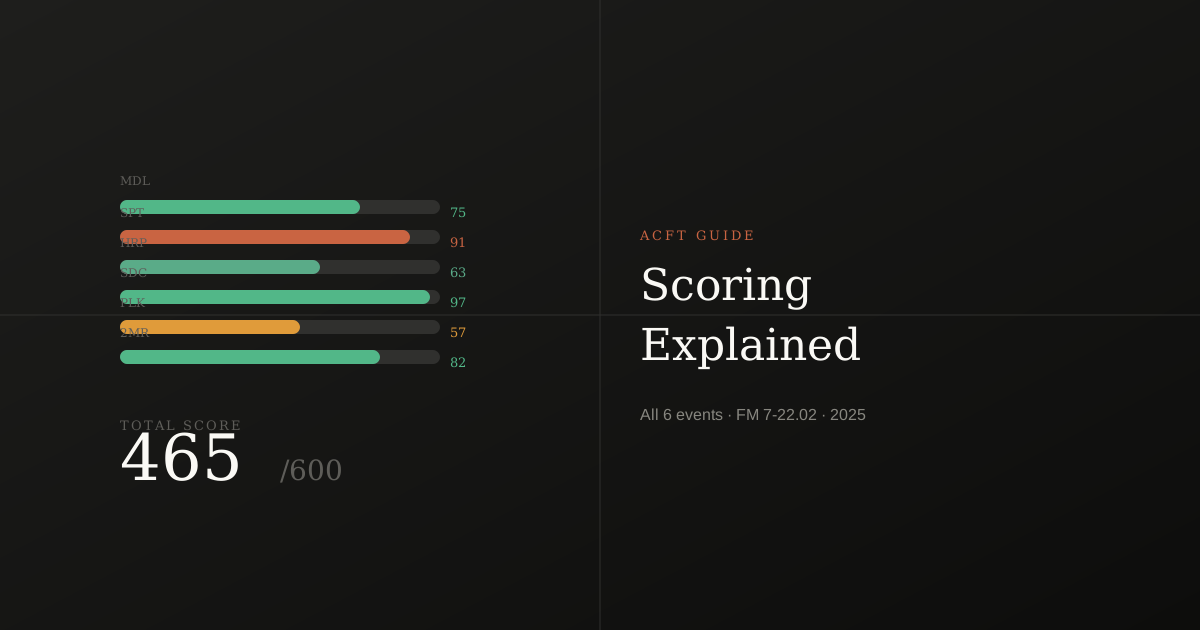
ACFT Scoring Guide: How the Army Fitness Test is Scored
Complete breakdown of all 6 ACFT events: scoring tables, pass/fail criteria, linear interpolation, a…
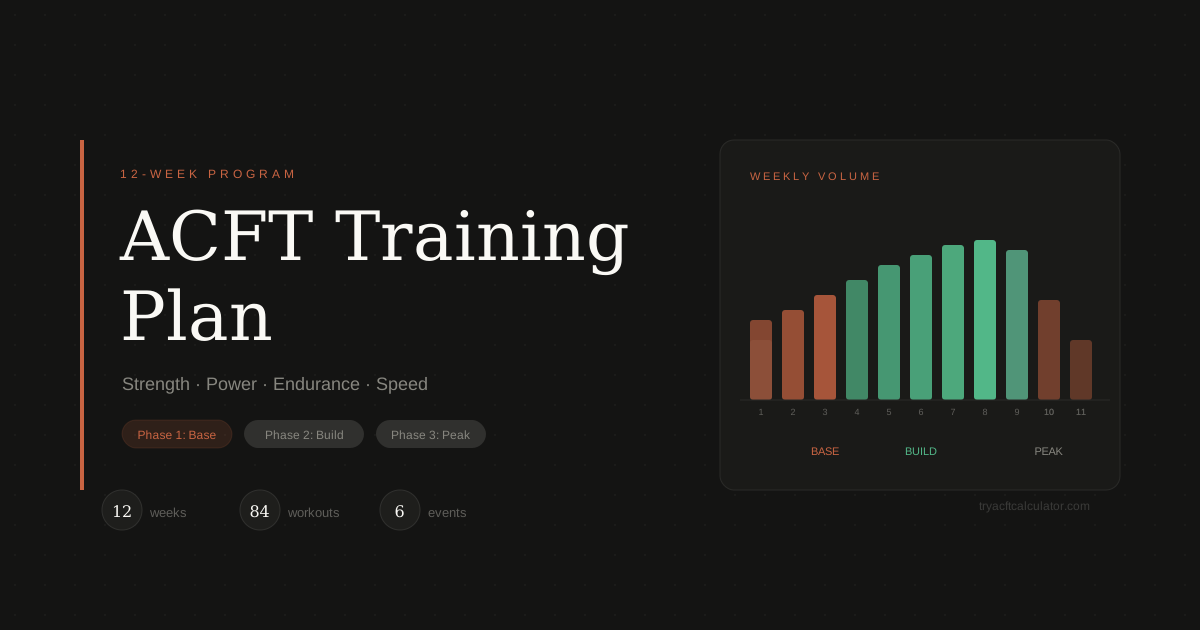
12-Week ACFT Training Plan to Max Your Score
Week-by-week ACFT training plan with periodization, event-specific programming, assessment week, nut…
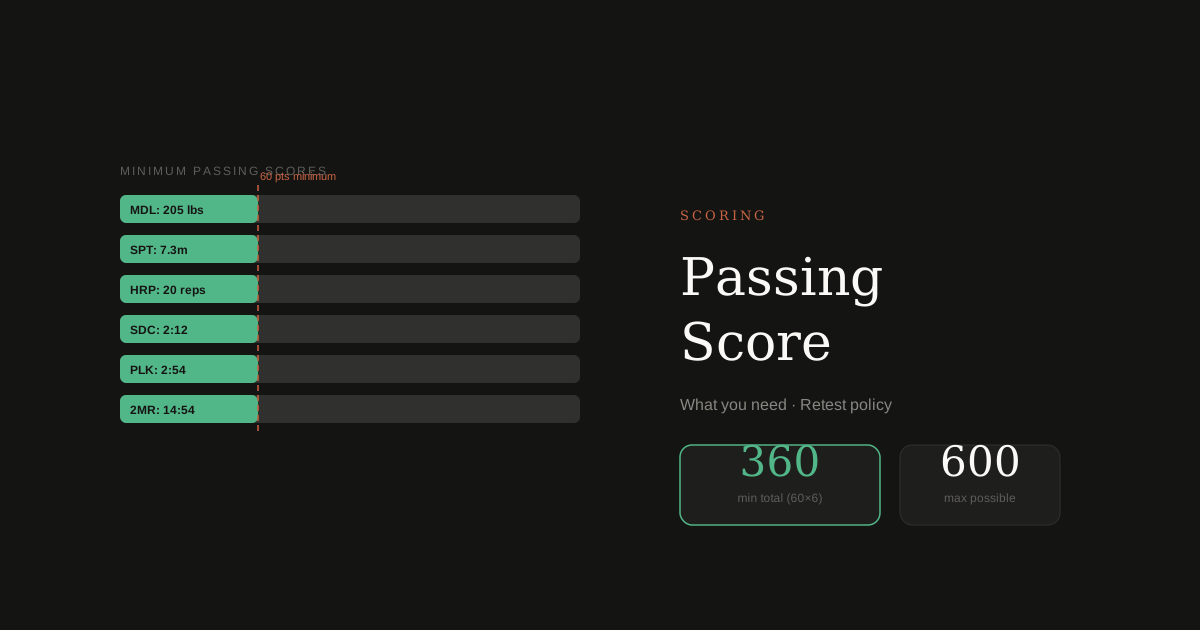
ACFT Passing Score: Minimums, Requirements & Retest Policy
Everything you need to know about ACFT minimum scores, per-event passing thresholds, what a perfect …