Science-backed strategies to improve your ACFT 2MR time. Interval training, tempo runs, pacing strategy, and common mistakes that slow you down.
The two-mile run is the final event of the ACFT and the one most soldiers have the most history with. It's been in Army fitness testing since the APFT era. But familiarity with the event doesn't mean soldiers are training it effectively. Most soldiers who consistently score 15:30 to 17:00 on the 2MR aren't limited by their aerobic capacity. They're limited by how they train. They run the same moderate pace every day, never develop speed, and plateau years before reaching their potential.
This guide covers the science-backed training methods that actually move the needle on 2MR times, from the soldier who needs to clear 14:54 to the one chasing 13:30.
Check your current 2MR score with the two-mile run calculator, and use the full ACFT calculator to see how it fits into your overall score.
Understanding the ACFT 2MR Scoring
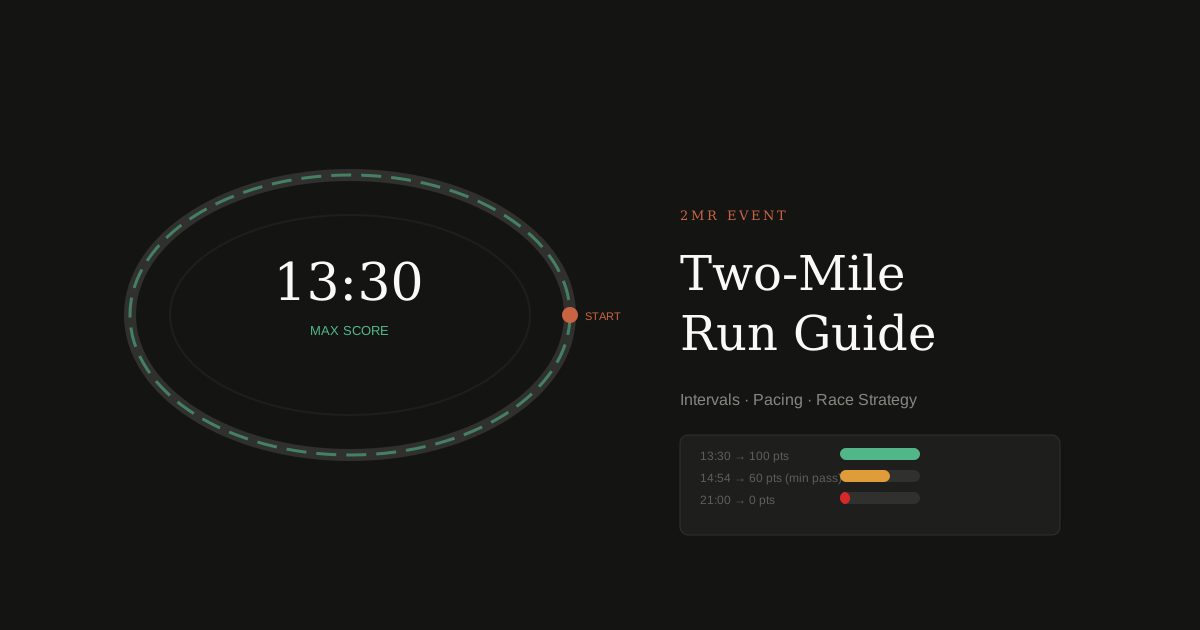
The minimum passing time is 14:54 (60 points). The 100-point time is 13:30. Between those thresholds, every 6 seconds of improvement is worth roughly 2 points.
| Goal Time | Points | Per-Mile Pace |
|---|---|---|
| 13:30 | 100 | 6:45/mile |
| 14:00 | 84 | 7:00/mile |
| 14:30 | ~72 | 7:15/mile |
| 14:54 | 60 ✓ | 7:27/mile |
| 15:30 | ~47 | 7:45/mile |
| 16:00 | ~38 | 8:00/mile |
| 17:00 | ~26 | 8:30/mile |
| 18:00 | ~15 | 9:00/mile |
A soldier currently running 16:30 who improves to 14:54 gains 12+ points on this event alone, the equivalent of significant improvements in multiple other events. The 2MR is often the highest-ROI event for soldiers who've been neglecting running-specific training.
The Physiology of the 2MR
The two-mile run (3.2 km) sits between a 5K and a mile in its physiological demands. Unlike the mile, which is largely anaerobic, and unlike a 10K, which is almost entirely aerobic, the 2MR requires:
- Primary aerobic system (roughly 85 to 90%): Your aerobic capacity (VO2 max) and lactate threshold determine your sustainable pace
- Anaerobic contribution (roughly 10 to 15%): The final 400 to 800 meters and any surges require anaerobic energy system support
Training the 2MR needs both aerobic base development and anaerobic speed work. Soldiers who only do slow easy runs build the aerobic base but never develop the speed ceiling needed to run 7:27/mile or faster. Soldiers who only sprint and do short intervals lack the aerobic engine to sustain any pace for two full miles without a major slowdown.
The goal of 2MR training is to raise both the aerobic base (allowing you to hold a faster pace sustainably) and the VO2 max / lactate threshold (allowing that faster pace to remain aerobically manageable).
The Three Training Pillars for 2MR Improvement
Pillar 1: Easy Aerobic Runs (2 to 3x per week)
Easy runs build your aerobic base, the physiological foundation that everything else relies on. "Easy" has a specific definition: you should be able to hold a full conversation without pausing for breath. For most soldiers, this is 60 to 90 seconds per mile slower than goal 2MR pace.
If your goal is 14:30 (7:15/mile), your easy runs should be at roughly 8:45 to 9:15/mile. This feels slow. It should.
What easy runs actually build:
- Capillary density in working muscles (more oxygen delivery per unit of muscle)
- Mitochondrial density (more energy production per cell)
- Improved fat utilization efficiency (sparing glycogen for hard efforts)
- Increased stroke volume and cardiac output
- Better recovery between harder training sessions
Volume targets for 2MR improvement:
- 3 easy runs per week, 20 to 35 minutes each
- Total weekly mileage of 15 to 25 miles is a solid aerobic stimulus for 2MR improvement
- Soldiers currently running less than 10 miles per week will see the most rapid improvement from adding easy volume
Common mistake: Running "moderate" all the time. Moderate pace isn't easy enough to build the aerobic base optimally, and not hard enough to stimulate VO2 max improvement. It's the least effective training zone for developing distinct fitness adaptations.
Pillar 2: Interval Training (1x per week)
Interval training directly targets VO2 max, your maximum aerobic capacity. It's the most powerful tool for improving 2MR time in a limited training window, especially for soldiers who already have a solid aerobic base but have plateaued at a moderate time.
Why intervals work: Running at faster-than-race pace for short durations forces your cardiovascular system to operate near its maximum capacity. Over time, this raises the ceiling. Your maximum oxygen consumption increases, meaning the same pace requires less aerobic effort.
Effective interval structures for 2MR improvement:
400m repeats (most accessible): Run 6 to 10 × 400m at 5 to 10 seconds per lap faster than goal 2MR pace. Rest 60 to 90 seconds between reps (walk or easy jog).
Example: Goal 2MR is 14:30 (roughly 1:49 per 400m). Run intervals at 1:44 to 1:47 per 400m. Rest 75 seconds.
This workout trains your body to run faster than race pace, which makes race pace feel more manageable.
800m repeats (more race-specific): Run 4 to 6 × 800m at exactly your goal 2MR pace. Rest 2 to 3 minutes between reps.
This is the closest single-rep simulation of 2MR demands. Running at goal pace for 800m under controlled conditions teaches your body the precise effort level needed.
1-mile repeats (advanced): Run 2 to 4 × 1 mile at goal 2MR pace. Rest 3 to 4 minutes between reps.
High-quality, race-specific workout. Reserve this for soldiers who are already running 35+ miles per week with a consistent quality session history.
Progression: Start with 400m intervals. After 4 to 6 weeks, add 800m repeats. After 8 to 10 weeks, if the training is going well, test 1-mile repeats. Avoid jumping to longer intervals before you have the base to support them. It leads to form breakdown, injury, and slower improvement.
Pillar 3: Tempo Runs (1x per week)
A tempo run is a "comfortably hard" effort. Sustainable, but not comfortable. It's faster than easy pace and slower than interval pace. Typically 20 to 30 seconds per mile slower than your 2MR pace.
If your goal 2MR pace is 7:27/mile, your tempo pace would be roughly 7:47 to 7:57/mile.
What tempo runs build: Lactate threshold, the speed at which your body produces lactic acid faster than it can clear it. This is the physiological limiter for sustained hard effort. Raising your lactate threshold means you can run faster without "going into the red."
Standard tempo run format:
- 10 minutes easy warm-up
- 20 to 30 minutes at tempo pace (continuous, not broken into intervals)
- 10 minutes easy cool-down
Progression: Start with 20 minutes of tempo work. Add 5 minutes every 2 weeks until you reach 30 to 35 minutes of sustained tempo effort. This is a hard workout. It should feel challenging throughout, but you should be able to complete it without stopping or significantly slowing.
8-Week 2MR Improvement Plan
This program uses the three-pillar model and can be added alongside regular unit PT. It assumes you aren't currently doing structured running work. If your unit already runs 4+ days per week, replace 1 to 2 of those runs with these quality sessions.
| Week | Easy Runs | Interval Session | Tempo Session | Weekly Mileage |
|---|---|---|---|---|
| 1 | 2 × 25 min easy | 6 × 400m @ goal pace −5s | 20 min tempo | ~15 miles |
| 2 | 2 × 30 min easy | 8 × 400m @ goal pace −5s | 20 min tempo | ~17 miles |
| 3 | 2 × 30 min easy | 5 × 800m @ goal pace | 22 min tempo | ~19 miles |
| 4 | 2 × 25 min easy (recovery) | 4 × 800m (easier effort) | 20 min tempo | ~15 miles (recovery) |
| 5 | 3 × 30 min easy | 5 × 800m @ goal pace | 25 min tempo | ~21 miles |
| 6 | 3 × 30 min easy | 3 × 1 mile @ goal pace | 25 min tempo | ~22 miles |
| 7 | 2 × 30 min easy | 6 × 400m (sharpener) | 20 min tempo | ~18 miles |
| 8 (taper) | 2 × 25 min easy | 4 × 400m easy | None | ~12 miles |
Key notes:
- Week 4 is a deliberate recovery week. Don't skip it. Accumulated training fatigue requires deloading to convert to fitness gains.
- Taper in week 8 reduces volume while maintaining some intensity. Your body needs rest to show its best performance.
- After the 8 weeks, test your 2MR and use the results to set the next training block.
Pacing: The Most Underrated 2MR Skill
The majority of soldiers run significantly slower 2MR times than they're physiologically capable of, because they start too fast. Positive splitting (going out faster in mile 1 than mile 2) results in dramatically slower total times because the energy debt accumulated in the first mile compounds across the second.
Research on pacing: For events of 2 to 10 minutes, even-split or slightly negative-split (mile 2 slightly faster than mile 1) strategies consistently produce faster total times than positive-split strategies. For an Army 2MR, the difference between a 5-second positive split and a 5-second negative split can be 15 to 25 seconds of total time.
Target split strategy for a 14:30 goal (7:15/mile average):
- Mile 1: 7:20 (5 seconds slower than average)
- Mile 2: 7:10 (5 seconds faster than average)
This isn't about holding back dramatically in mile 1. It's about resisting the adrenaline-fueled surge that most soldiers experience at the start of a timed run, and running mile 1 at a pace that leaves you capable of running mile 2 faster.
How to Practice Pacing
The only way to develop pacing skill is to practice it with a watch. During training runs, run the first mile at your target 1-mile pace and note how it feels. If it feels easy, you're probably on target. If it feels hard, you're going too fast for your current fitness.
On a 400m track (2-mile = 8 laps):
- Lap 1 (400m): slightly conservative, just below goal lap pace
- Laps 2 to 4 (400 to 1600m): settle into goal pace, confirm with watch at each lap
- Lap 5 (1600m): this is the mile mark, should feel hard but manageable
- Laps 6 to 7: push pace slightly if feeling good
- Lap 8 (final 400m): everything left, full controlled surge to the finish
Common 2MR Mistakes That Kill Your Score
Mistake 1: Training only at moderate pace
If every run is at the same moderate pace, your body adapts to that pace and stops improving. This is the single most common reason soldiers plateau at 16:00 to 17:00 and stop improving despite consistent PT. Add intervals and tempo runs to your rotation.
Mistake 2: Running exclusively on a treadmill
Treadmills provide assistance (the moving belt carries your foot backward) and the biomechanics differ from overground running. Training for a timed run on treadmills is less effective than training outdoors on a similar surface to your test course. If you must use a treadmill, set the incline to 1% to approximate outdoor running resistance.
Mistake 3: Neglecting lower body strength training
Runners who also perform lower body strength training (squats, deadlifts, lunges, hip thrusts) run more efficiently than those who only run. Running economy, the energy cost of maintaining a given pace, is directly improved by leg and hip strength. You don't need to be a powerlifter. Twice-weekly lower body strength work is enough.
This is even more relevant for ACFT training because the deadlift (MDL) training you do for event 1 also improves your running economy for event 6.
Mistake 4: Increasing mileage too rapidly
The "10% rule": don't increase your weekly mileage by more than 10% per week. A soldier jumping from 15 miles per week to 30 miles in 2 weeks is asking for a stress fracture, shin splints, or an IT band issue. The training volume that produces fitness gains is also the training volume that creates overuse injuries if increased too fast.
Mistake 5: Ignoring the test-day context
The 2MR is the last of six ACFT events. When you toe the line for the run, you've already done three heavy deadlift reps, two power throws, 2 minutes of push-ups, a 90-second obstacle course, and 5 minutes of planking. You aren't starting fresh.
In training, practice your 2MR after a simulated partial test. At minimum, after strength work that approximates the first five events. This trains your body to perform aerobically under partial glycogen depletion and physiological fatigue, which is the actual test-day condition.
Mistake 6: Skipping the warm-up
The 2MR is the last event, so your body is warm. But "warm" from a rest period between events isn't the same as primed for maximal running performance. A brief 200 to 400m jog at easy pace 5 to 10 minutes before the run starts activates your aerobic system and prepares your stride mechanics. Don't sit down and stop moving in the period between events and the run start.
Cross-Training for Soldiers With Running Injuries
Running injuries (shin splints, stress fractures, knee pain, IT band syndrome) are common in Army training environments. When running volume must be reduced, cross-training can maintain aerobic fitness:
- Cycling: High aerobic stimulus with minimal impact loading. A 45-minute cycling session approximates the aerobic benefit of a 30-minute run.
- Rowing: Full-body aerobic work that also builds pulling strength. Rowing at moderate intensity for 20 to 30 minutes is a solid aerobic substitute.
- Pool running (aqua jogging): Maintains run-specific neuromuscular patterns while eliminating ground-reaction force. The closest cross-training substitute for running.
- Elliptical: Moderate aerobic substitute. Less specific to running mechanics than pool running but much more accessible.
Cross-training doesn't replace running for developing running-specific fitness, but it maintains aerobic base and prevents the complete deconditioning that occurs with total rest.
Injury Prevention: Staying Healthy Through a Running Training Block
The most common 2MR training injuries and how to prevent them:
Shin splints (medial tibial stress syndrome):
- Caused by: too much too soon, hard surfaces, inadequate footwear
- Prevention: progressive mileage increases (10% rule), cushioned footwear, calf stretching, and strengthening exercises (calf raises, tibialis raises)
IT band syndrome:
- Caused by: tight hip abductors and iliotibial band, often from rapid mileage increase
- Prevention: lateral band walks, clamshells, hip strengthening, foam rolling the lateral quad and hip
Plantar fasciitis:
- Caused by: tight calf and plantar fascia, high training volume on hard surfaces
- Prevention: daily calf and plantar stretching, supportive footwear, gradual mileage increases
Stress fractures:
- Caused by: excessive training volume, poor nutrition (low calcium/Vitamin D), rapid mileage increases
- Prevention: 10% rule, adequate calcium and Vitamin D intake, strength training to build bone density
Any bone pain (not muscle soreness) that persists more than 48 hours warrants medical evaluation. Running through a potential stress fracture converts a 6-week injury into a 3-month one.
For a complete program that covers all six ACFT events, see the 12-Week ACFT Training Plan. For context on how the 2MR fits into your overall ACFT score, see the ACFT passing score guide and the ACFT Scoring Guide.
Frequently Asked Questions
How long does it take to improve 2MR time by 1 to 2 minutes?
With consistent structured training (3 to 4 runs per week including one quality session), most soldiers can improve 1 to 2 minutes in 8 to 12 weeks. Soldiers starting from a high base (18+ minutes) often improve faster initially. Soldiers already running sub-14:30 face harder marginal gains.
Should I run more miles or run faster to improve?
Both, in sequence. First build your aerobic base (4 to 6 weeks of increased easy mileage), then add quality sessions (intervals and tempo runs) on top of that base. Adding high-intensity work without base fitness increases injury risk and limits the benefit you can extract from the quality sessions.
Can I walk during the 2MR?
Yes. There's no rule against walking. But the minimum passing pace of 7:27/mile requires continuous running for almost all soldiers. Walking slows the average pace dramatically. The minimum is approximately a 7:30/mile pace continuously. Even brief walking will likely push your time over 14:54.
How should I warm up for the 2MR on test day?
Because the 2MR is the final event, your body is already warm from the previous five. A brief 200 to 400m easy jog 5 to 10 minutes before the run starts is enough to transition from the rest period back into running movement. Don't sprint or perform heavy drills. Conserve energy.
What is optimal running cadence for the 2MR?
Research suggests 170 to 180 steps per minute reduces injury risk and improves running economy. Most recreational runners run at 160 to 165. Increasing your cadence by 5 to 10% through conscious practice (counting steps, using a metronome app) can improve both speed and comfort over time.
Is treadmill running equivalent to outdoor running for ACFT prep?
Not exactly. Treadmill running provides 2 to 4% less resistance than outdoor running at equivalent speeds. If you must train on a treadmill, set the incline to 1% to compensate. You should also include some outdoor runs, especially in the final 3 to 4 weeks before your record test, to ensure your body is adapted to the overground mechanics.
Free Calculator
Ready to check your score?
Use the free ACFT calculator to instantly score all 6 events based on official FM 7-22.02 standards.
Open ACFT Calculator →Related Articles
ACFT Scoring Guide: How the Army Fitness Test is Scored
Complete breakdown of all 6 ACFT events: scoring tables, pass/fail criteria, linear interpolation, a…
12-Week ACFT Training Plan to Max Your Score
Week-by-week ACFT training plan with periodization, event-specific programming, assessment week, nut…
ACFT Passing Score: Minimums, Requirements & Retest Policy
Everything you need to know about ACFT minimum scores, per-event passing thresholds, what a perfect …