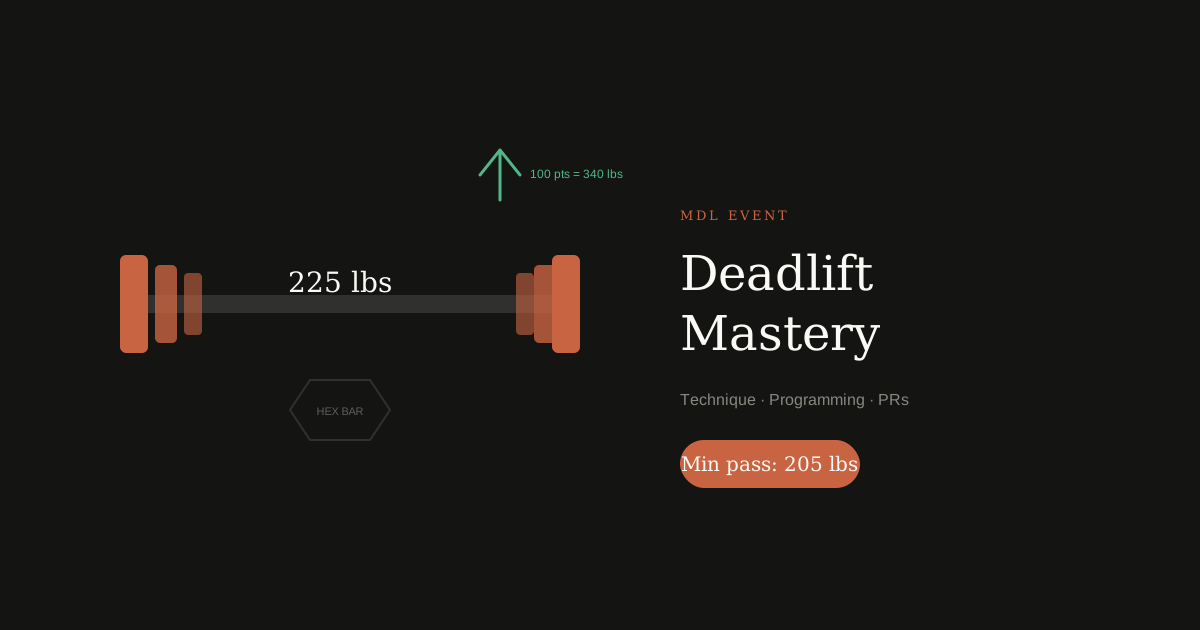
Improve your ACFT 3 Rep Max Deadlift: proper hex bar form, 12-week progressive programming, grip training, and what to avoid on test day.
The 3 Repetition Maximum Deadlift is one of two pure strength events on the ACFT, and for soldiers who have never trained the deadlift specifically, it can be the difference between passing and failing. The good news: the hex bar deadlift is one of the most trainable lifts in existence. Most soldiers can reach the 205-lb minimum within 8 to 16 weeks of focused training, and with a year of consistent work, approaching 280 to 300 lbs is realistic for many.
Use the deadlift calculator to check your current score and set a specific target weight. Then use this guide to build the program that gets you there.
The Hex Bar vs Straight Bar: Why Equipment Matters
The ACFT uses a hex bar (also called a trap bar), not a standard straight barbell. This distinction matters for both technique and training, and soldiers who have been training straight-bar deadlifts need to understand the differences.
Mechanical Differences
With a straight bar, you stand behind the bar and the load hangs in front of your shins. With a hex bar, you stand inside the bar with handles on both sides at your hips. This repositions the load from in front of your center of gravity to directly alongside it, producing several important mechanical changes:
- Reduced lower-back moment arm: The load travels more vertically relative to your spine, reducing the forward-lean torque that makes straight-bar deadlifts stressful on the lumbar spine
- Increased quad contribution: The hex bar movement is a squat-deadlift hybrid. Your knee angle at setup is greater, engaging the quadriceps more than a straight-bar pull
- More accessible technique: The neutral grip handles and inside-the-bar position are more natural for athletes without deadlift-specific training, which is why the Army chose this implement
Translating Your Numbers
If you've been training straight-bar deadlifts, your hex bar performance will generally be 10 to 30 lbs higher due to the mechanical advantages. A soldier who can straight-bar deadlift 185 lbs for 3 reps can often do 200 to 215 on the hex bar immediately. This is useful to know for setting realistic initial test targets.
The Handle Height Detail
Most hex bars have two sets of handles: low handles (at the frame of the bar, roughly 8 to 9 inches from the floor) and raised handles (an extra 2 to 4 inches higher). The ACFT typically uses the raised handles for standardization, which shortens the range of motion slightly and makes the lift a bit easier than low handles.
Train with the raised handles when possible. This matches what you'll face on test day and trains the specific range of motion that will be scored.
ACFT MDL Scoring: Where the Points Are
Before building a program, understand the scoring curve so you can set efficient targets:
| Weight (lbs) | Points | Notes |
|---|---|---|
| 140 | 0 | Below minimum table |
| 185 | 46 | Just below passing |
| 205 | 60 | Minimum pass |
| 230 | 70 | Solid passing score |
| 250 | 76 | Strong performance |
| 300 | 86 | Requires serious strength training |
| 320 | 90 | Competitive score |
| 340 | 100 | Maximum. Exceptional strength. |
The scoring curve is front-loaded. The gain from 140 to 205 lbs (0 to 60 points) requires more raw strength development than the gain from 250 to 340 lbs (76 to 100 points) does in percentage terms. But absolute strength gains in the 205 to 280 range are highly achievable for most soldiers with 3 to 6 months of training.
The most efficient point targets:
- 205 lbs = 60 pts: The mandatory first goal. 3 months of work for most untrained soldiers.
- 250 lbs = 76 pts: Reachable within 6 months for many soldiers. Significant point gain for modest extra work.
- 280 lbs = 82 pts: A strong competitive score. Requires 9 to 12 months of consistent training.
Step-by-Step Hex Bar Deadlift Technique
Technique matters for two reasons: it maximizes force output (so you lift more), and it keeps your spine safe (so you can train consistently without injury). These are the same goal.
Step 1: Setup. Foot Position and Bar Centering
Stand inside the hex bar with your feet hip-width apart, centered between the handles front-to-back. Your feet should be positioned so that when you hinge down to grab the handles, your shins are roughly vertical (not angled dramatically forward or back).
Common setup error: standing too far forward in the bar. This shifts the load forward and increases lower-back stress. If you're standing in the correct position, the handles should be directly beside your outer thighs when you're standing upright.
Step 2: Hinge and Grip
Hinge at your hips first, pushing them back rather than squatting straight down. Once your hands reach handle height, bend your knees to lower your hips to the starting position. This sequence teaches the hip hinge pattern and prevents excessive knee forward travel.
Grip the handles with a double-overhand grip, both palms facing toward each other (neutral). The ACFT requires this grip. No mixed grip (one palm forward, one back) is allowed. Your arms should be fully extended. Don't bend your elbows to try to pull the bar with your arms.
Squeeze the handles hard. Maximum grip tension before the bar leaves the ground creates full-arm and lat engagement.
Step 3: Brace. 360-Degree Core Pressure
Before the bar moves, take a large diaphragmatic breath (into your belly, not your chest) and brace your entire core as if you're about to take a punch. This is called intra-abdominal pressure (IAP), and it creates a rigid cylinder of pressure around your spine that protects it during the lift.
Cues for proper bracing:
- "Big air into your stomach"
- "Make your abs hard all the way around"
- "Brace like someone is about to push you"
This brace should be held through the entire rep, from the moment the bar leaves the floor until it returns.
Step 4: The Drive. Push Floor Away, Not Pull Bar Up
The most important cue for a mechanically efficient deadlift: push the floor away with your feet while also pulling the handles up. Soldiers who only think "pull" tend to initiate the lift with their lower back. Soldiers who think "push" naturally drive through their legs and keep a better back angle.
As the bar rises, your hips and shoulders should rise at the same rate. If your hips shoot up first while your shoulders stay low, you've converted the lift to a stiff-leg movement that overloads the lower back.
Keep the bar traveling in a straight vertical line from start to lockout. Any horizontal drift adds unnecessary moment arm to the lift.
Step 5: Lockout. Hips, Not Hyperextension
At the top, achieve lockout by driving your hips forward to full extension. Your torso should be vertical, with your shoulders directly over your hips and heels. Squeeze your glutes at the top.
Do not hyperextend your lower back at the lockout. Leaning back past vertical places the spine under compressive load in an extended position. That's an injury pattern that builds up over many training sessions. Stand tall, not backward.
Step 6: The Descent. Controlled for Reps 1 and 2
For a 3-rep max, your descent matters. On reps 1 and 2, lower the bar under control. Hip hinge first, then bend the knees once the bar passes knee height. This preserves your setup position for the next rep.
On the final rep, you can let the bar drop from the lockout position rather than controlling the descent. This is standard practice on max-effort sets and saves energy for the critical effort.
3-Rep Max Pacing: It's Different Than 1-Rep Max Training
A 3-rep max requires more than just picking up heavy weight. You have to maintain technique across three consecutive reps under accumulating fatigue.
Key pacing considerations:
- Take a full breath and brace before every rep. Don't rush the reset between reps 1, 2, and 3
- Brief pause at the floor between reps to re-establish position. Don't bounce reps
- Rep 2 is always the hardest: Rep 1 has fresh muscles, rep 3 has adrenaline. Rep 2 is where form typically breaks down first
- Control rep 1. Soldiers who treat rep 1 as a warm-up and try to grind out reps 2 and 3 often fail. Every rep should look the same
Common MDL Faults and How to Fix Them
Rounding the Lower Back
What it looks like: The spine flexes into a rounded position during the pull, especially in the lumbar region. The head drops, the upper back rounds.
Why it happens: Either the load is too heavy, the brace is insufficient, or the lift is initiated by pulling rather than pushing.
Fix: Reduce load by 10 to 20%, practice the brace setup for 10 seconds before every rep, and use the "chest up, push floor" cue through the lift.
Hips Shooting Up First
What it looks like: Bar begins to move, but hips rise much faster than shoulders. The final position looks like a stiff-leg deadlift.
Why it happens: Weak quads relative to hamstrings/glutes, or a setup position where the hips are too low (like a squat).
Fix: Romanian deadlifts (hip hinge without significant knee bend) to reinforce the proper drive pattern. Also check that your setup hip height is appropriate. Hips should be between your knee height and shoulder height, not at squat depth.
Jerking the Bar Off the Floor
What it looks like: A rapid yank at the start that causes the bar to move jerkily and often produces back rounding.
Why it happens: Trying to use momentum to "break" the bar off the floor. Usually happens when the load is at or near maximum.
Fix: Deliberately "take the slack out" of the bar before the pull. In the brace position, create tension in the system. You should hear the bar plates settle and feel the handles load before driving. The initial movement should feel like you're squeezing the bar up, not ripping it.
Letting the Bar Drift Forward
What it looks like: The bar moves in an arc away from the body as it rises, rather than straight up.
Why it happens: Lat engagement is insufficient. The bar drifts forward because nothing is actively keeping it close to the body.
Fix: "Protect your armpits" or "pull your shoulder blades toward your back pockets" during setup. This lat engagement cue keeps the bar path vertical through the lift.
Bar Hitching
What it looks like: Using a brief rest on the thighs midway through the lift, then continuing. This is a rules violation in the ACFT. The bar has to travel continuously from floor to lockout.
Why it happens: Load is too heavy or grip is failing.
Fix: Reduce load so you can complete clean reps, and add grip-specific training (see below).
12-Week MDL Training Program
This program runs three deadlift sessions per week across three phases. Each phase builds on the last. If you're already training consistently, you can start in Phase 2.
Phase 1: Weeks 1 to 4. Technique and Volume
The goal in Phase 1 is building movement quality and initial strength base. Use moderate loads and controlled technique on every rep.
Session A (Monday, Strength):
- Hex bar deadlift: 5 x 5 at 65 to 70% of estimated max
- Romanian deadlift: 3 x 10 (reinforces hip hinge)
- Goblet squat: 3 x 12 (builds quad strength)
- Farmers carry: 3 x 40 yards at heavy weight (grip development)
Session B (Wednesday, Volume):
- Hex bar deadlift: 4 x 8 at 55 to 60%
- Glute bridge: 3 x 15 (glute activation)
- Good morning: 3 x 12 (lower back endurance)
- Dead hang: 3 x max time (grip)
Session C (Friday, Moderate Intensity):
- Hex bar deadlift: 4 x 5 at 70%
- Single-leg Romanian deadlift: 3 x 10 per side
- Hip thrust: 3 x 12
Week 4: Test your 3-rep max to establish baseline. Add 5 lbs per week to Session A on the primary work set.
Phase 2: Weeks 5 to 8. Strength Development
Session A (Monday, Heavy):
- Hex bar deadlift: 5 sets, building to a heavy triple (target: 85 to 90% of 3RM)
- Pause deadlift: 2 x 3 (2-second pause just above the floor. Increases tension and teaches patience at the bottom.)
- Farmers carry: 4 x 50 yards at maximum possible weight
Session B (Wednesday, Moderate):
- Hex bar deadlift: 4 x 4 at 75 to 80%
- Romanian deadlift: 4 x 8
- Hip thrust: 4 x 10
- Plate pinch: 3 x 30 seconds (grip)
Session C (Friday, Volume):
- Hex bar deadlift: 5 x 5 at 72 to 75%
- Deficit deadlift (stand on 2-inch plate): 3 x 5 (builds strength off the floor, transfers to full lift)
- Towel pull-ups: 3 x max reps (grip + pulling strength)
End of Phase 2 benchmark: Hit a new 3-rep max. Should be 15 to 25 lbs above your Phase 1 test.
Phase 3: Weeks 9 to 12. Peak and Test Preparation
Session A (Monday, Peak Strength):
- Hex bar deadlift: Work to a heavy 3-rep set (90 to 95% of recent 3RM)
- Week 9: 90% x 3
- Week 10: 93% x 3
- Week 11: 95% x 3
- Week 12 (test week): 60% x 3 (light activation only)
Session B (Wednesday, Submaximal Volume):
- Hex bar deadlift: 4 x 3 at 80%
- Farmers carry: 3 x 50 yards
- Anti-fatigue core work: plank 2 x max
Session C (Friday, Reduced in weeks 11 to 12):
- Week 9 to 10: Hex bar deadlift 4 x 5 at 75%, plus accessories
- Week 11: Hex bar deadlift 3 x 3 at 70%, no accessories
- Week 12: Rest
Grip Strength: The Hidden Limiting Factor
Many soldiers plateau in the deadlift not because their legs are weak, but because their hands give out first. The hex bar handles are thicker than a standard barbell, about 1.5 inches in diameter, which significantly increases the grip demand compared to a 1-inch barbell.
The ACFT also prohibits lifting straps. You must deadlift with your own grip strength, double-overhand, with no mechanical assistance.
Grip Training That Transfers to the MDL
Farmers carry: Load two heavy kettlebells or dumbbells and walk for time or distance. This is the single best functional grip builder because it combines the same static grip demand with the same handle diameter as the test. Start at 50% of your bodyweight per hand and build toward 75 to 100%.
Dead hangs: Hang from a pull-up bar with a double-overhand grip until your grip fails. Multiple sets of 30 to 60 seconds develop the finger flexors and forearm flexors that are the first to fatigue in the deadlift.
Plate pinch: Pinch two 10-lb plates together (smooth sides out) and hold for 30 to 45 seconds. This builds the pinch strength that stabilizes the grip around the hex bar handles.
Towel pull-ups: Drape a thick towel over a pull-up bar and do pull-ups gripping the towel. The unstable, thick surface creates a grip demand far higher than standard pull-ups and builds tremendous crush grip strength.
Add 10 to 15 minutes of grip work twice per week. Most soldiers see deadlift numbers improve within 4 to 6 weeks of adding targeted grip training.
Nutrition and Recovery for Strength Gains
Deadlift strength is a whole-body adaptation. It requires muscular hypertrophy, central nervous system adaptation, and connective tissue remodeling. All of these need adequate recovery inputs.
Protein: Aim for 0.7 to 1.0 grams of protein per pound of bodyweight per day. Most soldiers in heavy strength training phases undereat protein. This is the single most impactful nutritional lever for strength development.
Calories: Strength gains require adequate total caloric intake. If you're in a significant caloric deficit, strength development will slow. Prioritize performance over aesthetics during a 12-week strength block.
Sleep: Strength adaptations happen during sleep, mostly through growth hormone release in deep sleep. 7 to 9 hours per night is not a recommendation. It's a performance requirement.
Inter-session recovery: The deadlift is a taxing lift. Training it more than three times per week typically produces more fatigue than adaptation. The program above is designed for optimal stimulus-to-recovery balance.
Test-Day Strategy
The ACFT allows up to three deadlift attempts. You can increase weight between attempts, but you cannot decrease. Planning your attempts correctly is important.
Warm-Up Sets (Before Scored Attempts)
Arrive at the deadlift station having done 2 to 3 warm-up sets:
- Set 1: ~50% of target weight x 5 reps (technical warm-up)
- Set 2: ~75% of target weight x 3 reps
- Set 3: ~90% of target weight x 2 reps
These are practice sets. Don't count them as official attempts. Rest 2 to 3 minutes after your warm-up before your first scored attempt.
Attempt Scheme
Attempt 1: A weight you are 100% confident you can complete for 3 reps. For a soldier targeting 205 lbs (minimum pass), start at 185 to 195 lbs. This builds confidence, warms you up maximally, and makes sure you have a passing score if later attempts fail.
Attempt 2: Move up 15 to 20 lbs from attempt 1 if it felt solid. Move up only 5 to 10 lbs if it felt challenging.
Attempt 3: This is your true max effort. Based on how attempt 2 felt, decide realistically. A failed attempt 3 scores zero additional points over attempt 2. It only costs you energy and potentially confidence for the rest of the test.
Chalk and Equipment
Chalk is generally permitted at ACFT testing sites. Check your unit's specific test policy. It significantly reduces grip slipping and is worth using if available. Lifting belts are typically not permitted. Train without one.
For a complete overview of all six ACFT events and scoring, read the ACFT Scoring Guide. If you want to integrate MDL training into a full six-event program, see the 12-Week ACFT Training Plan. For preparation mistakes that might be holding you back, see 10 ACFT Preparation Mistakes.
Frequently Asked Questions
Do I need to train straight-bar deadlifts for the ACFT MDL? No. Train the hex bar specifically. The movement patterns differ enough that hex bar training is better for ACFT preparation. Straight-bar deadlifts are useful for building general pulling strength but shouldn't be your primary tool when preparing for the MDL.
How long does it take to reach 205 lbs from scratch? For most untrained soldiers, 8 to 16 weeks of consistent training (2 to 3 sessions per week) is enough to reach 205 lbs. Soldiers who have prior leg training (squats, leg press) or athletic backgrounds may get there faster. Soldiers with no training history or older beginners may need up to 20 to 24 weeks.
Can I use chalk or straps on the ACFT MDL? Chalk is generally permitted (confirm with your test OIC). Straps are not permitted. You must deadlift with your own grip strength. Train without straps from the beginning so your grip adapts to the demand.
What's the difference between the hex bar handle heights? Most hex bars have low handles (at the frame level) and raised handles (2 to 4 inches higher). The ACFT typically uses the raised handles. Training with the taller handles matches test conditions and slightly shortens the range of motion, making the lift a bit easier.
Should I use a lifting belt? Most ACFT testing sites do not permit lifting belts. More importantly, training with a belt can reduce the core stabilizer development that protects your spine over a career of load-bearing. Train without a belt so your natural stabilizers develop appropriately. If you're managing a back injury, consult your medical provider before training without a belt.
What if I fail my 3-rep max on a lighter attempt? It happens. If you fail attempt 1 or 2, stay composed. Take the full authorized rest period, assess what happened technically (back rounding? grip failure? hips shooting up?), and decide whether to retry the same weight or drop. A failed attempt is not the end. Remaining attempts still count if successful.
Free Calculator
Ready to check your score?
Use the free ACFT calculator to instantly score all 6 events based on official FM 7-22.02 standards.
Open ACFT Calculator →Related Articles
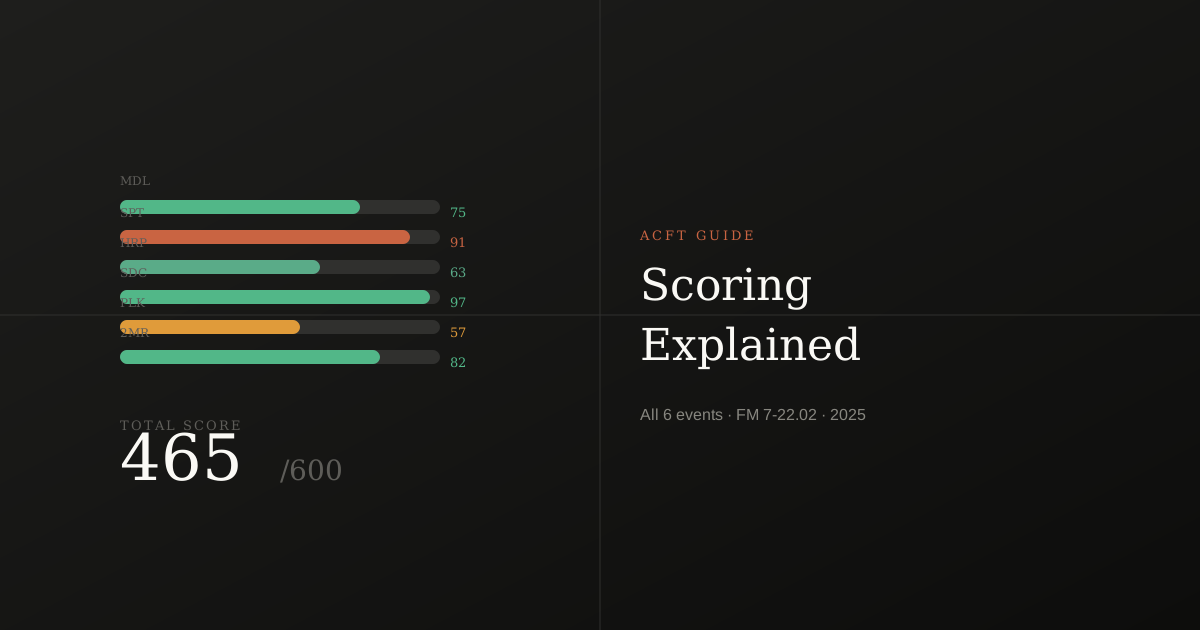
ACFT Scoring Guide: How the Army Fitness Test is Scored
Complete breakdown of all 6 ACFT events: scoring tables, pass/fail criteria, linear interpolation, a…
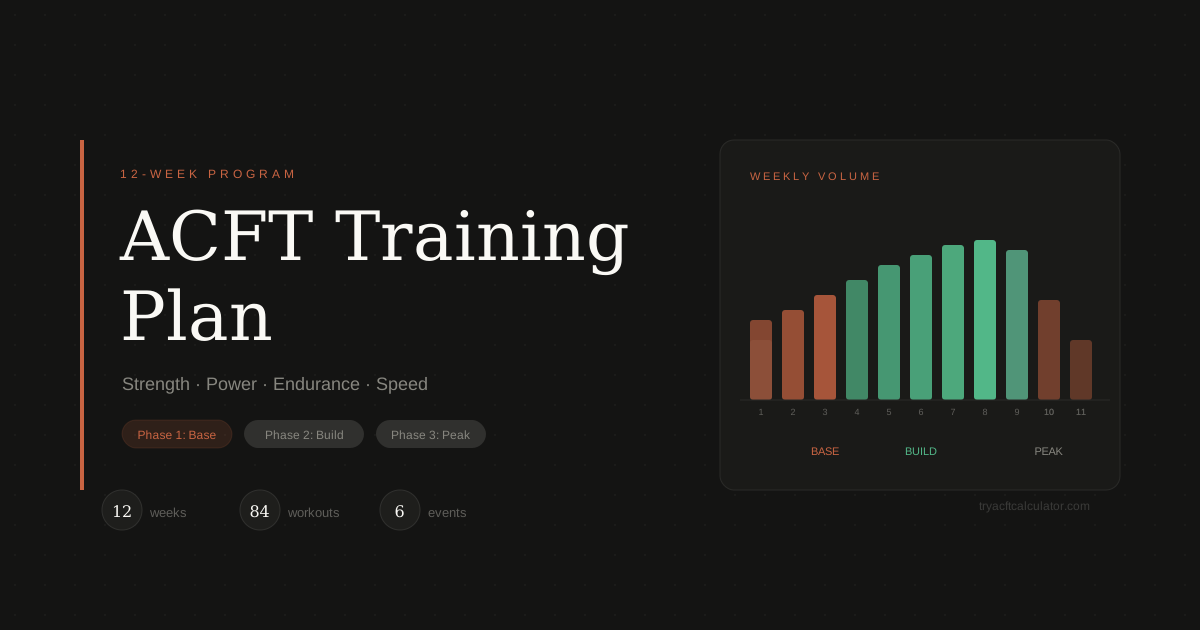
12-Week ACFT Training Plan to Max Your Score
Week-by-week ACFT training plan with periodization, event-specific programming, assessment week, nut…
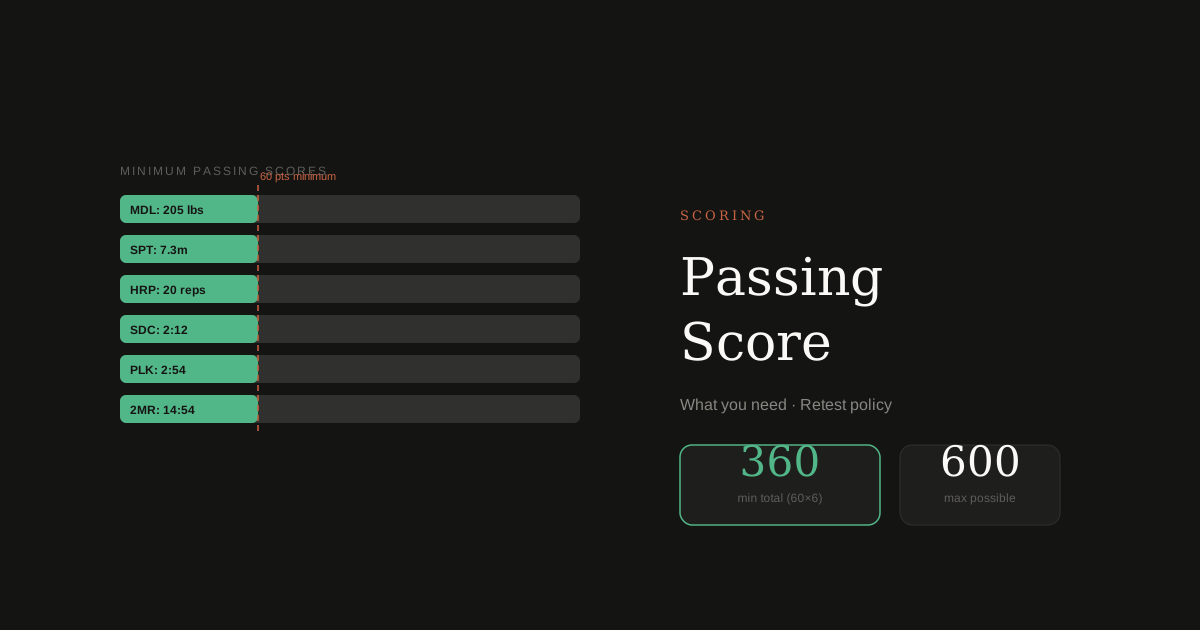
ACFT Passing Score: Minimums, Requirements & Retest Policy
Everything you need to know about ACFT minimum scores, per-event passing thresholds, what a perfect …