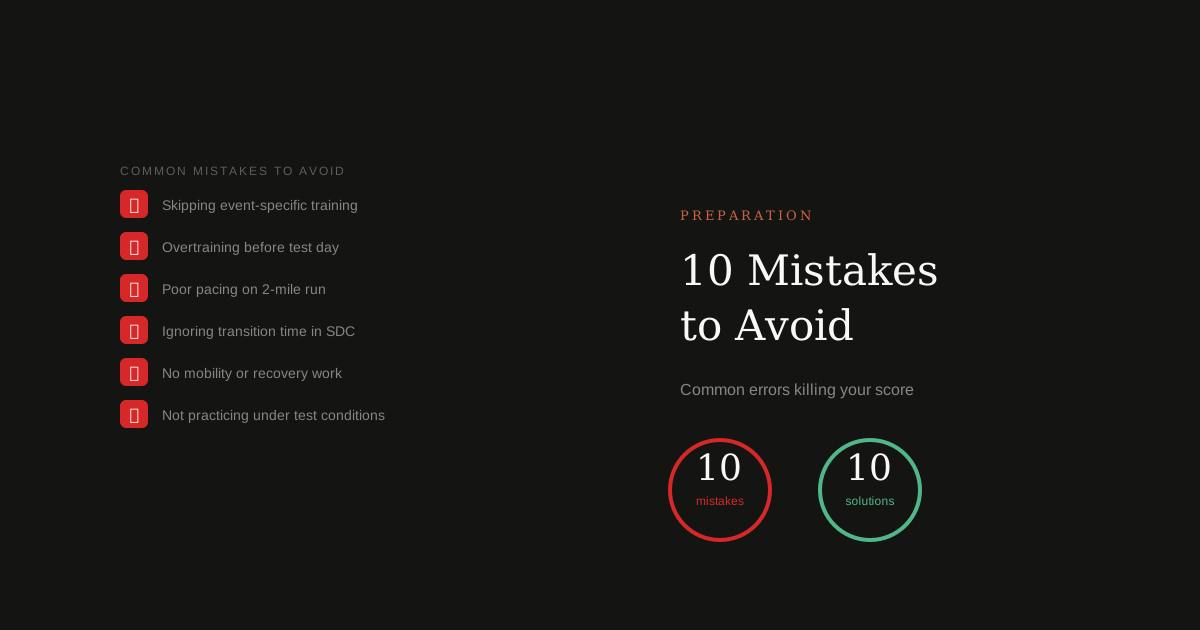
The most common training and test-day mistakes soldiers make on the ACFT, and exactly how to fix each one to stop leaving points on the table.
Most ACFT failures are preventable. After reviewing the most common patterns in how soldiers prepare for the test, the same mistakes show up repeatedly. Some training errors, some technique errors, some test-day management errors. This guide names them directly so you can stop making them.
Start by identifying your current weak events with the ACFT calculator, then use this guide to eliminate the preparation mistakes that are holding you back.
Mistake 1: Training Each Event in Isolation and Ignoring Cumulative Fatigue
Soldiers often train for the ACFT by practicing each event separately, on different days, with full recovery between them. On test day, they discover that performance under accumulated fatigue is significantly different from performance fresh.
The ACFT is administered in a fixed sequence: MDL, SPT, HRP, SDC, PLK, 2MR. With rest periods between events but no real recovery. By the time you're holding the plank, you've already deadlifted, thrown a medicine ball, completed 2 minutes of push-ups, and run an anaerobic shuttle. The 2MR happens at the end of all of that.
Soldiers who train each event in isolation often find that their isolated training times don't transfer. Their 2MR time slows by 30 to 90 seconds compared to a fresh run. Their HRP count drops. Their plank hold time falls short.
The fix: At least once per month during your training cycle, run a complete ACFT simulation in test order. This teaches your body how to perform under the specific fatigue pattern of the real test, and it reveals which events degrade most under fatigue. Which tells you where to focus training.
Also, on heavy training days, sequence events to create intentional fatigue. Run push-ups after a strength session. Do a plank hold after SDC simulation. Training under fatigue is the only way to prepare for performing under fatigue.
Mistake 2: Prioritizing Your Best Events Over Your Weakest
It feels good to train what you're already good at. High-rep push-up sessions feel productive when you can do 45 reps easily. Comfortable 2-mile runs feel like training when you're a natural runner. But neither adds meaningful points when you're already at 80+.
The ACFT has one non-negotiable rule: fail any event and you fail the test. A score of 59 on the MDL is a failure regardless of whether you scored 95 on everything else. The pass threshold of 60 points per event creates a binary outcome. Every event below 60 is worth zero as a passing score.
The math is simple: a 10-point gain on a failing event (say, 50 to 60 on the plank) is infinitely more valuable than a 10-point gain on a strong event (85 to 95 on the 2MR). One determines whether you pass. The other is a personal achievement.
The fix: Score every event right now using the ACFT calculator. Sort them from lowest to highest. Your bottom two events deserve 70% of your training attention. Your top two events need maintenance, not development. Rebalance your training accordingly and reassess every 4 weeks.
Many soldiers resist this advice because it means spending significant time on uncomfortable or unfamiliar training. That discomfort is exactly the signal that tells you where the work needs to happen.
Mistake 3: Not Practicing the Hex Bar Deadlift Specifically
The MDL uses a hex bar (trap bar), not a standard straight barbell. These are meaningfully different movements. The hex bar places the load at your sides, shifts the lift toward a squat-deadlift hybrid, and uses neutral grip handles at a specific height.
Soldiers who train straight-bar deadlifts or who do conventional strength training (back squats, leg press) but never touch a hex bar often discover on test day that the movement pattern feels unfamiliar, their grip isn't calibrated for the handle diameter, and their timing is off.
More critically: the 3-rep max format is specific. Doing heavy singles in training doesn't prepare you for the pacing required to grind three consecutive reps under maximum load.
The fix: Train the hex bar specifically. If your unit gym doesn't have one, find a commercial gym with a trap bar and use it at least once per week. Practice 3-rep sets at 85 to 90% of your max to build the specific pacing and fatigue management the test requires. Review full technique guidance in the ACFT Deadlift Tips guide.
Mistake 4: Positive-Splitting the Two-Mile Run and SDC
Positive splitting means running the first half faster than the second half. It's the most common pacing error in both the 2MR and the SDC, and it can cost significant time in both events.
In the 2MR: going out too fast in mile 1 means you accumulate a lactate debt that compounds in mile 2. Your pace involuntarily slows, your form degrades, and you cross the finish line 30 to 90 seconds slower than if you'd run even splits. Most soldiers who run a 16:00 two-mile run and wonder why they "fell apart in mile 2" ran the first mile in 7:30 or faster. Even splits (8:00 / 8:00) would have produced a better outcome.
In the SDC: the sprint phase comes first and last, creating a natural tendency to sprint at maximum effort in phase 1. By the time you reach the kettlebell carry in phase 4, your grip is failing and your legs are gone. The pivot back to the finish sprint becomes a stumble.
The fix for the 2MR: In training, deliberately run mile 1 at your goal pace minus 5 seconds per mile. If your goal is 16:00 (8:00 pace), run mile 1 at 8:05 pace. Use a GPS watch or time each lap on a 400m track. Practice even splits on every timed run. The sensation of going "too slow" in mile 1 is the correct sensation. Trust it. See the two-mile run guide for the full pacing system.
The fix for the SDC: Practice the full five-phase sequence with deliberate phase 1 pacing. Sprint phase 1 at 85 to 90% effort rather than 100%. This preserves enough energy for phases 2 through 4 and allows a stronger final sprint in phase 5. Practice the full sequence with a timer at least twice per week in the final month before your test.
Mistake 5: Ignoring Grip Strength
Two ACFT events have significant grip demands: the MDL (holding 200+ lbs on thick hex bar handles) and the SDC (strap drag and kettlebell carry). A third, the HRP, requires sustained pressing force through the hands. Grip fatigue can directly fail you on the MDL and cost multiple minutes on the SDC.
Many soldiers who train hard for the deadlift hit a performance ceiling not because their legs are weak, but because their hands fail first. During the SDC, soldiers who haven't specifically trained for grip endurance find the strap drag and kettlebell carry turn their hands into burning claws that affect every subsequent phase.
The fix: Add 10 to 15 minutes of targeted grip work twice per week, year-round:
- Farmers carry: 3 x 50m at 50 to 80% of your bodyweight per hand. This is the most direct grip builder for the MDL and SDC carries.
- Dead hangs: 3 x max time from a pull-up bar, double-overhand grip. The same grip used in the MDL.
- Plate pinch: Two 10-lb plates, smooth sides out, held for 30 to 45 seconds. Builds the finger strength that stabilizes the hex bar grip.
Don't wait until grip failure on a max-effort set to take this seriously. Add grip work now, before it becomes a problem.
Mistake 6: Skipping Mobility and Pre-Training Warm-Up
The ACFT's most injury-prone event is the MDL, and most MDL-related training injuries are preceded by inadequate warm-up and poor mobility in the hips and thoracic spine. Cold muscles and stiff joints in the deadlift produce rounded-back lifting, which is where strain accumulates.
More broadly: tight hip flexors reduce glute activation in both the deadlift and the plank. Poor shoulder mobility affects the power throw release angle and HRP positioning. Limited ankle dorsiflexion affects your setup depth in the deadlift.
Many soldiers skip warm-up because they're short on time or consider it optional. It is neither. It's injury prevention and a performance enhancer. A proper warm-up raises muscle temperature, increases joint range of motion, and activates the nervous system for maximum effort.
The fix: Spend 10 to 15 minutes on movement preparation before every training session:
- Hip 90/90 stretch: 60 seconds each side (internal and external rotation)
- Thoracic spine rotation: 10 reps per side
- Ankle dorsiflexion mobilization: 10 reps per side
- Band pull-aparts: 2 x 15 (shoulder health)
- 2 to 3 light warm-up sets before every heavy deadlift session
Post-training, spend 10 minutes on static stretching, particularly hip flexors, hamstrings, and upper chest. This isn't wasted time. It reduces next-session muscle soreness and maintains the range of motion you need for technical lifts.
Mistake 7: Training to Failure on Every Set
"Maximum effort every session" sounds like dedication. In practice, training to absolute muscular failure on every set is a poor strategy that produces excessive fatigue, slows recovery, increases injury risk, and limits the total volume of quality work you can perform per week.
This is a common pattern for soldiers who are highly motivated but haven't been exposed to periodization concepts. They equate suffering with progress. Some suffering is appropriate. Systematic, unmanaged exhaustion is not.
The science is clear: submaximal training (ending sets with 1 to 3 reps left "in reserve") allows more total quality volume per week, which drives more total adaptation. Training to failure occasionally is useful. Making it the default is counterproductive.
The fix: On your primary strength and conditioning work, leave 1 to 3 reps in reserve on most sets. Rate your effort on a 1 to 10 scale: most working sets should feel like a 7 to 8, not a 10. Save true maximum efforts for test simulations and periodic PR attempts. Once every 3 to 4 weeks.
Your body needs to be able to recover from today's session to adapt from it and be ready for tomorrow's. If you're consistently sore for 3+ days after every workout, you're outrunning your recovery capacity.
Mistake 8: Poor Transition Management in the SDC
The five phases of the Sprint-Drag-Carry (sprint, drag, lateral shuffle, kettlebell carry, sprint) are only part of the equation. The transitions between phases are where significant time is lost, and most soldiers who train the SDC without practicing full sequences never identify this gap until test day.
The specific transition problems:
- The drag-to-lateral pivot: After finishing the drag, you must drop the strap and immediately begin the lateral shuffle. Soldiers who haven't practiced this specific movement often stumble or hesitate.
- The lateral-to-carry pivot: You stop the lateral shuffle and must grab two 40-lb kettlebells. The setup (picking up both kettlebells cleanly while your grip is already fatigued) costs 3 to 5 seconds for unprepared soldiers.
- The carry-to-sprint transition: Putting the kettlebells down and converting immediately to a sprint requires specific practice.
Across all transitions, 10 to 20 seconds can be saved simply by practicing the changeover footwork.
The fix: Practice complete SDC simulations (all five phases with transitions) at least twice in the final two weeks before your test. On these simulations, focus specifically on:
- The exact footwork at each cone pivot
- The grab-and-go for the kettlebell pickup (both bells in one smooth motion)
- The controlled drop of the kettlebells at the end of the carry phase
For the full SDC strategy, see the Sprint-Drag-Carry guide.
Mistake 9: Making Major Changes the Week Before the Test
Test anxiety drives soldiers to do things in the final week that actively harm their performance: extra long runs "to build last-minute fitness," heavy deadlift sessions "to peak," 100-rep push-up sets "to sharpen the event." None of this helps. All of it hurts.
The physiological reality: fitness adaptations from hard training take 7 to 14 days to manifest. Any hard training performed in the week before your test doesn't improve your score on test day. It adds fatigue that degrades performance. A soldier who runs 10 miles on the Tuesday before a Friday ACFT is slower on Friday than a soldier who rested.
This mistake is especially damaging because it's motivated by good intentions and feels productive. It is not productive.
The fix: The final week before your test should follow a deliberate taper:
- Easy runs of 15 to 20 minutes (maintaining neuromuscular activation without fatigue)
- Light sets of each event at 60% effort. Just to keep movement patterns warm.
- 8+ hours of sleep per night
- Normal diet. This isn't the week to try new supplements or pre-workout products.
- No new exercises or movements. This isn't the week to "try something different."
Trust the work you've done in the previous 11 weeks. Taper is part of the program, not slacking off.
Mistake 10: Underestimating the Plank Until It's Too Late
The plank is often dismissed as the "easy" event. After all, you're just lying still. This perception leads soldiers to deprioritize PLK training until they discover, often late in their prep cycle, that they're failing or borderline on it.
The minimum passing time is 2:54. For a soldier who's never specifically trained isometric core holds, nearly three minutes is genuinely difficult. The discomfort begins early and intensifies progressively. The plank is also the event that comes directly after the SDC, when your core, legs, and grip are already taxed.
The specific error: starting plank-specific training too late. Plank endurance responds to training, but it responds over weeks, not days. A soldier who starts training the plank four weeks before their test will improve, but probably not enough from a poor starting point. A soldier who starts three months out can reach the 2:54 minimum comfortably and potentially hit 3:30+.
The fix: Start training the plank now, regardless of your test date. 3 to 4 dedicated plank sessions per week with progressive overload (adding time each session) builds the endurance you need. Full-body tension technique (especially glute engagement) can add 30 to 60 seconds to your hold time immediately upon correct application.
Read the complete protocol in the ACFT Plank Tips guide, which includes an 8-week progressive training program starting from any baseline.
Bonus: Not Using Score Data to Drive Training Decisions
Soldiers frequently train based on feel, habit, or unit PT schedules rather than data. Without knowing exactly what your current scores are and where the point gains per training hour are most efficient, you're making uninformed training decisions.
Using the ACFT calculator and event-specific calculators before and during your training cycle:
- Shows you exactly which events are failing vs. passing
- Quantifies how many points each extra unit of performance is worth (a 10-lb deadlift gain may be worth 2 points. A 5-second improvement in SDC time may be worth 4 points.)
- Tracks progress objectively rather than through subjective feel
- Helps you identify whether you're on track for test day or need to adjust
For example: a soldier running 15:30 on the 2MR (74 points) who deadlifts 210 lbs (62 points) should be spending most of their training time on the deadlift, not the run. The run is already passing with margin. The deadlift barely passes. A deadlift improvement to 250 lbs would add 14 points. Getting the 2MR from 15:30 to 15:00 adds only 6 points. Data makes this obvious. Training without data hides it.
Frequently Asked Questions
What is the most commonly failed ACFT event? Data patterns suggest the SDC and MDL have among the highest failure rates, followed by the 2MR for certain demographic groups. The PLK also produces a significant number of failures among soldiers who underestimate it or start training too late. The SPT is frequently underscored by soldiers who haven't worked on technique and hip drive mechanics.
How long before my ACFT should I start comprehensive preparation? Twelve weeks is the ideal preparation timeline for addressing all six events systematically. If you have 8 weeks, prioritize your weakest events and accept that some events will receive maintenance-only attention. Anything under 6 weeks requires triage. Focus exclusively on events at risk of failing.
Is it possible to improve significantly in less than 4 weeks? Meaningful gains are possible in 4 weeks, particularly in skill-dependent events (SDC transitions, SPT throw technique), endurance events with fast adaptation curves (plank, push-ups), and any event where technique is currently costing you performance. Strength-based events (MDL) are slower to respond and require longer development windows.
Should I train with a partner? Yes, particularly for push-up form grading, SDC timing and simulations, and plank accountability. A training partner can grade your HRP form in real time (the hand release is easy to shortchange when fatigued), accurately time your SDC phases, and keep you honest during plank holds when the urge to quit arrives. Partner training isn't required, but it accelerates progress in several events.
What if I'm on a profile (medical restriction)? Work within your profile and focus intensive training on the events you can train. Inform your chain of command early about any medical limitations. Don't attempt to train through pain or injury before a test. An injury that sidelines you from the test entirely is a far worse outcome than a modest score on a limited event. Seek a medical recovery plan and resume full training when cleared.
Free Calculator
Ready to check your score?
Use the free ACFT calculator to instantly score all 6 events based on official FM 7-22.02 standards.
Open ACFT Calculator →Related Articles

ACFT Scoring Guide: How the Army Fitness Test is Scored
Complete breakdown of all 6 ACFT events: scoring tables, pass/fail criteria, linear interpolation, a…
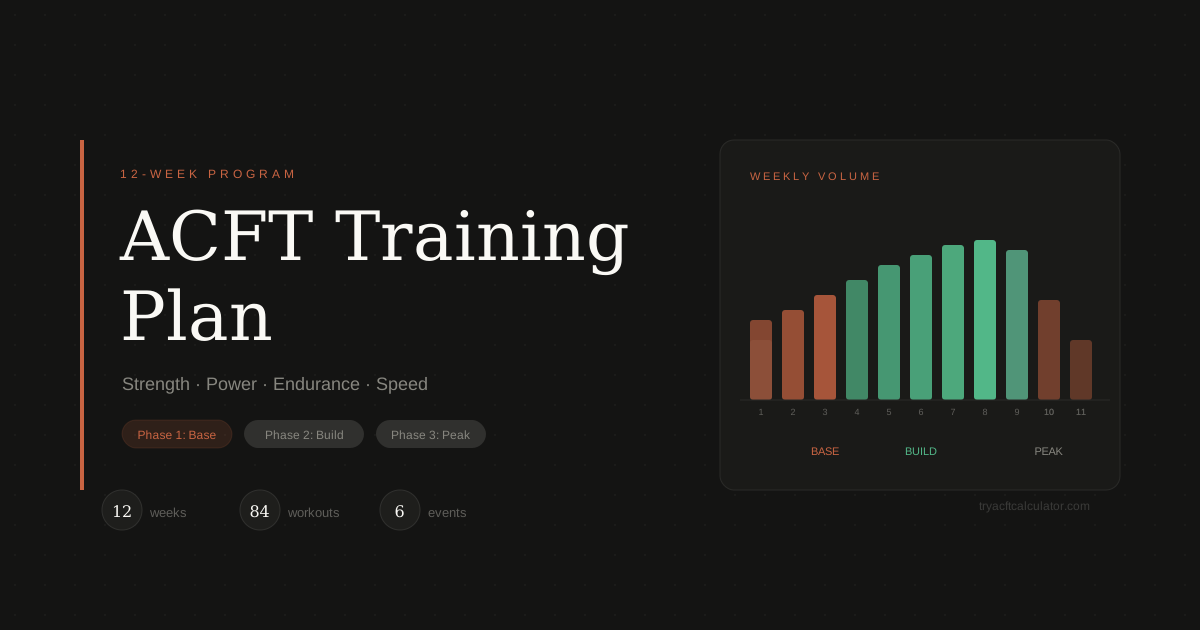
12-Week ACFT Training Plan to Max Your Score
Week-by-week ACFT training plan with periodization, event-specific programming, assessment week, nut…
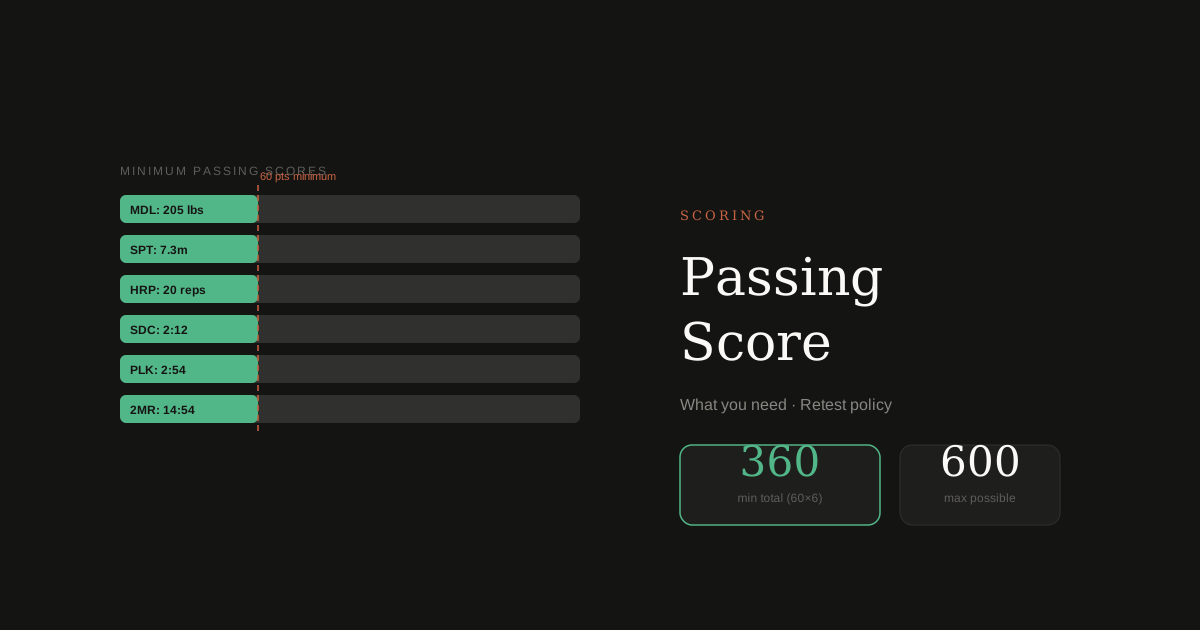
ACFT Passing Score: Minimums, Requirements & Retest Policy
Everything you need to know about ACFT minimum scores, per-event passing thresholds, what a perfect …